
Good Secondary 1 math tuition should diagnose the gap before teaching the topic, rebuild primary-school fluency where it is missing, and convert model-drawing habits into algebraic reasoning. Topic revision alone rarely fixes a Secondary 1 problem. A first lesson should therefore look more like assessment than instruction.
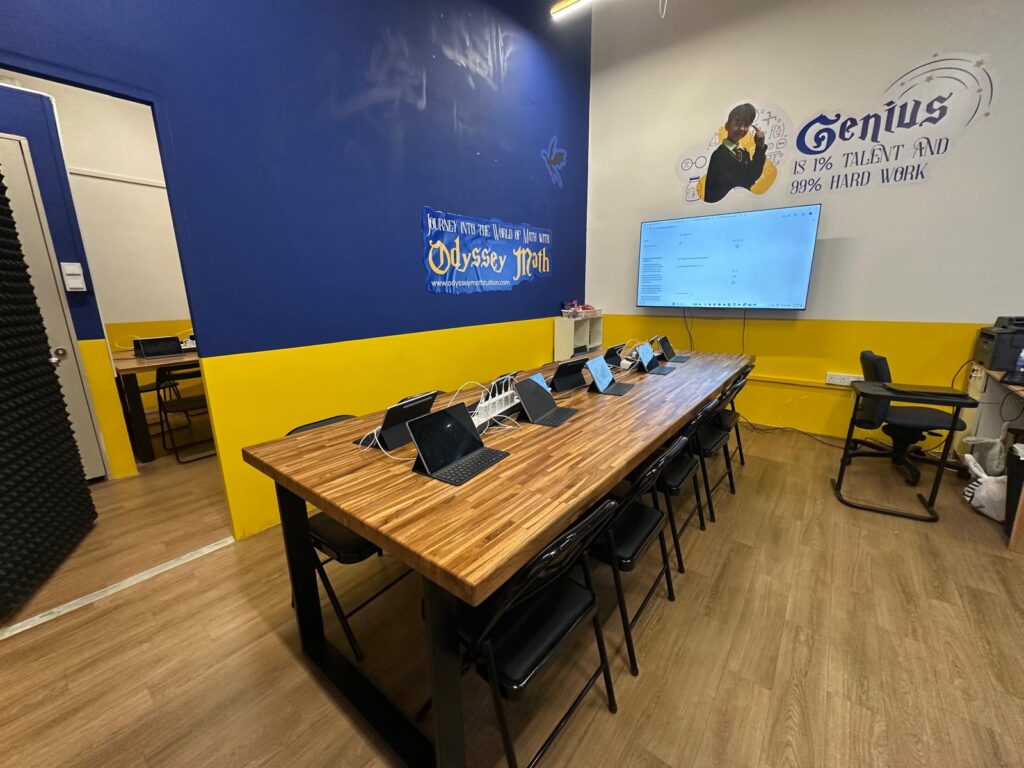
Parents ask us a reasonable question: what actually happens in a Secondary 1 math tuition lesson? It is a fair thing to want to know before committing a year of Saturday mornings. This piece opens the classroom door and describes what we do, why we sequence it that way, and what you should expect to see from any centre worth its fees.
The honest answer is that a good lesson looks less impressive than parents expect. There is not much lecturing. A tutor who is talking for most of the session is usually not finding out very much, because the information you need lives in what the student writes when they are stuck, not in whether they nod while you explain.
What we describe below is our own sequence rather than a universal standard, and other centres reasonably do it differently. But the principles underneath it — diagnose before prescribing, repair the layer beneath the presenting problem, build fluency deliberately — are ones we would apply anywhere, and they give you something concrete to ask about wherever you end up.
The first lesson is mostly diagnosis
Mostly diagnosis, not teaching. A student arrives described as “weak in algebra”, and roughly half the time algebra is not the problem. The gap sits further back — in negative numbers, in fraction operations, or in the habit of reading a word problem for structure rather than for keywords.
We hand a student a past-year paper, set the real time limit, and watch where they pause. The pause locates the gap far more reliably than a score does. You can run the same check at home with our free Secondary 1 past-year papers.
Teaching the current topic harder does not repair the layer beneath it
Because teaching this week’s topic harder does not repair a layer underneath it — it stacks on top. A student who is shaky with directed numbers will keep producing sign errors in every algebra topic for the next four years. Two weeks spent rebuilding that layer saves two years of recurring errors.
This is the least glamorous part of the work and the part that matters most. It is also why progress in the first month can look slower than parents expect, and then accelerate.
Moving off model drawing takes a bridge, not an instruction
Gradually, and without treating the model as a mistake. The bar model is excellent reasoning; it is simply the wrong notation for secondary school. We ask students to draw the model and write the equation side by side for a few weeks, so the translation becomes visible. Then the model quietly drops away on its own.
The reason for the gentleness is that the bar model is genuinely good reasoning, and children know when something they were praised for last year is suddenly being treated as a bad habit. Framed that way, a student tends to lose confidence in their own judgement at the same moment they are being asked to learn a new notation — which is the worst possible combination.
Framed as a translation instead, the same student usually makes the switch within a few weeks and keeps the underlying reasoning intact. The unit in the model and the x in the equation are the same object. Once a student sees that correspondence for themselves, algebra stops being a new subject and becomes shorthand for something they already do well.
Students who are told to “stop drawing models” without that bridge tend to lose confidence and accuracy at the same time.
Sit in on a lesson first. We run a free trial class at our centre at Hexacube, 160 Changi Road — about three minutes from Eunos MRT. Message us on WhatsApp to book, or see class schedules and fees. See what we cover in this level.
A term, week by week
- Weeks 1–3: diagnostic work and foundation repair — directed numbers, fractions, order of operations
- Weeks 4–8: algebraic manipulation to fluency — expanding, factorising, simplifying
- Weeks 9–12: linear equations and word-problem translation
- Throughout: timed practice under examination conditions, because fluency is a separate skill from understanding
The full topic sequence sits on our Secondary 1 math tuition page, and the same material is available as an online Secondary 1 course if your schedule suits self-paced study better.
Class size matters only as a proxy for attention
Small enough that a tutor notices a student who has stopped writing. That is the practical test. In a class of thirty, a quiet student who is lost can go unnoticed for a term. The specific number matters less than whether anyone is watching. Our class sizes and schedules are published so you can judge for yourself.
It is worth being specific about why this matters more than it sounds. A Secondary 1 student who does not understand something rarely announces it. They copy, they nod, and they wait for the worksheet, at which point they will attempt what they can and leave the rest. In a room where the tutor circulates and reads working, that is caught the same day. In a room where it is not, the student may practise a wrong method for a term and arrive at the examination having rehearsed the error thoroughly.
Three things worth watching at home
- Can they explain a step, not just perform it? Procedure without explanation collapses under examination pressure.
- How long does homework take? Ninety minutes for a thirty-minute set is a fluency signal, regardless of accuracy.
- Are the same errors recurring? Repeated sign errors or fraction slips indicate a foundation gap, not carelessness.
Prefer to learn at home? The online course for this level follows the same syllabus and the same sequence we teach in class, with worked video solutions your child can replay as often as they need. There is a free sample video for every level from Secondary 1 to JC2 if you would like to see the teaching first. You can also join us in person at our Eunos centre.
For the wider picture across levels, see our secondary school math tuition overview, or how our classes work generally.
Read next
See our complete Secondary 1 parent guide for the year in full, the Sec 1 syllabus topic by topic for the content, and Sec 1 tuition rates for what it costs. Before enrolling anywhere, what actually happens in a trial lesson and group versus one-to-one tuition are worth reading. If you are still choosing a school, our list of secondary schools in Singapore covers each school’s programmes, streams and strengths. On studying this online, see Primes, HCF and LCM: A Secondary 1 Revision Guide, Volume and Surface Area of Pyramids, Cones and Spheres: A Sec 2 Guide and Linear Equations: A Secondary 1 Revision Guide.
Related guides
Frequently asked questions
How soon should we see progress from Secondary 1 tuition?
In our own classes, understanding has usually shifted within three to four weeks, with marks moving a term or so later. That lag is normal — comprehension improves before speed does, and examinations test both. Be cautious of anyone promising a faster timeline.
Is one lesson a week enough for Secondary 1?
For most Secondary 1 students, yes, provided practice happens between lessons. Secondary 1 content is not voluminous; the challenge is fluency, and fluency is built by spaced repetition rather than by longer single sessions.
Should my child do tuition and an online course at the same time?
Rarely necessary. Choose the format that fits your household. Online works well for self-directed students and awkward schedules; in-person suits students who need someone to notice when they have stopped.
How do I know whether the tuition is actually working?
Within about a month you should have a specific answer about what your child’s difficulty is — not “needs more practice”, but something concrete such as which topic the gap traces back to. After that, in our classes, understanding has usually shifted in three to four weeks with marks following roughly a term later.
What happens if my child misses a lesson?
Ask any centre this before enrolling, since policies vary widely. Ours are set out on the schedules and fees page. More broadly, what matters is whether missed content is made available afterwards, since a student who misses the lesson that introduces a topic will feel it for weeks.
Is online tuition as effective as in-person for Secondary 1?
It depends entirely on the student. Online works well for self-directed learners and awkward schedules, and our courses cover the same syllabus with replayable worked solutions. It works less well where the real difficulty is attention, because a recording cannot notice when a student has disengaged.
Do you provide materials, or should we buy assessment books?
Materials are provided. Most students already own more assessment books than they use; what tends to be missing is targeted practice aimed at a diagnosed gap rather than more volume. Our free past-year paper library is available whether or not a student attends classes.
A note on what we can and cannot promise: the patterns described here come from what we have seen in our own classes over the years. They are not a forecast for any individual student. Progress in mathematics is produced jointly — our teachers work hard for a student who is willing to put in the effort, with support at home. We do not promise grades.
Last reviewed July 2026. Syllabus details follow the Ministry of Education and SEAB published documents.