
The five biggest changes from Primary 6 to Secondary 1 mathematics are the shift from model drawing to algebra, a roughly doubled teaching pace, formal notation, less repetition in class, and the assumption that practice happens at home. Most of the adjustment happens in Term 1, and a wobble in that period is normal rather than diagnostic.
If your child has just finished PSLE, the next few months are quieter than the last few were — and that quiet can be misleading. The mathematical demands of Secondary 1 are different in kind, not just in difficulty, and the students who settle fastest are usually the ones whose parents knew what was coming.
The quiet is worth using well, but not in the way most holiday advertising suggests. The families whose children settle fastest in January are not usually the ones who spent December on an intensive programme. They are the ones who knew what was coming, said so plainly, and let their child arrive rested and unafraid of the first difficult week.
A child who expects Secondary 1 mathematics to feel different is far better placed than one who expects it to feel like more of the same, because the first genuinely confusing lesson lands as information rather than as evidence that something has gone wrong with them.
Nothing here requires you to do mathematics with your child. It is simply what changes, and what it looks like from the outside.
1. Model drawing gives way to algebra
The bar model is a genuinely elegant tool, and Singapore teaches it better than almost anywhere. In Secondary 1 it gradually gives way to algebraic notation. Students are expected to translate a worded situation directly into an equation.
What makes this hard to spot from home is that the marks often hold up for a while. A capable child can keep producing correct answers with a model long after the class has moved to equations, and nothing in the report book will flag it. The cost shows up later, under time pressure, when a method that takes ninety seconds is competing with one that takes twenty.
Children who keep drawing models often still reach correct answers, but usually more slowly than an equation would take, and some questions ask specifically for an algebraic method. This is the single most common invisible problem of Secondary 1. Our Secondary 1 programme spends real time on this translation.
2. The pace increases sharply
A primary topic taught over three weeks may be covered in one. There is less in-class repetition, and the assumption is that consolidation happens at home. Students who relied on classroom repetition feel this immediately.
3. Notation becomes formal
Presentation starts to carry marks. Working must be shown in a particular way, and answers must be expressed in required forms. Many able students lose marks in Secondary 1 for reasons that have nothing to do with their mathematics.
4. Assessment becomes less frequent and more consequential
Primary school offers frequent small checks. Secondary school concentrates weight into fewer, larger assessments. A gap can therefore run undetected for longer — which is why the early home checks below matter.
The practical consequence for parents is that you lose the early-warning system you had grown used to. In primary school, a gap surfaced within a fortnight because something was marked every week. In secondary school it can run for most of a term before an assessment catches it. That is not a failure of the school; it is simply how the year is structured, and it means the informal checks you do at home carry more weight than they used to.
5. Independence is assumed
Nobody chases a Secondary 1 student for undone practice in the way primary school did. For some children this is liberating; for others it is the actual problem, and it is an organisational issue rather than a mathematical one. Worth diagnosing honestly before booking tuition.
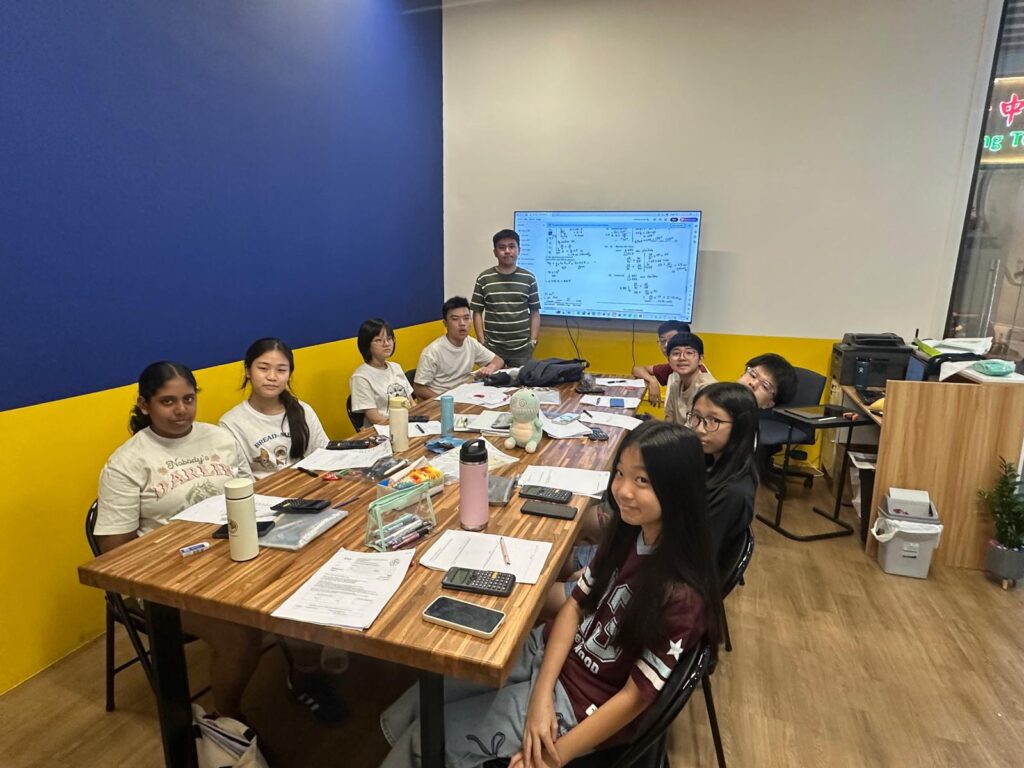
Sit in on a lesson first. We run a free trial class at our centre at Hexacube, 160 Changi Road — about three minutes from Eunos MRT. Message us on WhatsApp to book, or see class schedules and fees. See what we cover in this level.
The holidays need less work than the internet suggests
Less than the internet suggests, and it should be light. Three things are genuinely useful:
If you want a single principle for the holidays, it is this: protect the appetite. A child who starts Secondary 1 curious about a subject will absorb a difficult term far better than one who starts it already tired of the subject. Fifteen minutes of fractions twice a week costs almost nothing and keeps the machinery warm. Six weeks of daily worksheets buys a small head start and can cost something much harder to rebuild.
- Fraction and negative-number fluency. Fifteen minutes, twice a week. These are the two foundations Secondary 1 algebra leans on hardest.
- One gentle introduction to letters standing for numbers — not a course, just the idea, so the notation is not startling in January.
- Rest. Genuinely. A child who starts Secondary 1 exhausted from a holiday programme is worse off than one who starts curious.
If you would like to see the standard for yourself, our Secondary 1 past-year papers are free to download, and the Primary 6 page shows where your child is coming from.
Not in Term 1
Not in Term 1. Almost every Secondary 1 student wobbles somewhere in the first few months, and most of it is adjustment rather than ability. The signals worth acting on are persistent: the same errors recurring across weeks, homework taking dramatically longer than peers, or a child who has begun describing themselves as bad at maths. Our FAQ covers timing in more detail.
Read next
Once term starts, our complete Secondary 1 math guide covers the year, and why strong PSLE students sometimes stumble covers the most common surprise. The method change is set out in model drawing versus algebra, and the Primary 6 year is what your child has just finished. On the schools themselves, our list of primary schools in Singapore and list of secondary schools in Singapore cover both sides of the transition. On studying this online, see Percentage: A Secondary 1 Revision Guide, Linear Inequalities: A Secondary 2 Revision Guide and Expansion and Factorisation Using Special Identities: A Sec 2 Guide.
Related guides
Frequently asked questions
Should we arrange math tuition before Secondary 1 starts?
Usually not. Most students benefit more from starting school, meeting the actual demands, and then deciding. The exception is a child who finished PSLE with clear gaps in fractions or negative numbers, where a short foundation refresh before January is genuinely useful.
My child got AL1 for PSLE math. Do we still need to prepare?
Preparation is not about ability. A very strong PSLE result reflects mastery of a method that Secondary 1 partly retires. Some of the students who find Term 2 hardest are those who were most fluent with model drawing, because they have more to unlearn.
How long does it take to adjust to Secondary 1 math?
For most students, one term. By the end of Term 1 the notation feels normal; by Term 2 the pace does. Students still visibly struggling at the end of Term 2 usually have a specific gap worth locating.
Should we do a holiday programme before Secondary 1 starts?
Usually a light one at most. Fifteen minutes of fraction and negative-number practice twice a week is more useful than an intensive course, and rest matters genuinely. A child who begins Secondary 1 exhausted is worse placed than one who begins curious, whatever the head start on content.
How much math homework should a Secondary 1 student expect?
Schools vary, but around ninety minutes a week of mathematics practice outside school is typical and sufficient for most students at this level. What matters more than the total is whether the time is focused — thirty minutes of concentrated work beats ninety minutes of distracted work reliably.
My child is going to an Integrated Programme school. Is this different?
The transition is similar but the pace is faster, since IP schools compress mainstream content to create room for enrichment and early A-Level material. IP students who struggle usually need consolidation of material they have already met once, rather than remedial re-teaching.
Do you run classes for Secondary 1 students from any school?
Yes. The mathematics syllabus is national, so a Secondary 1 student struggling with algebra has the same gap whichever school set the paper. Most of our in-person students come from the east of Singapore simply because travel time after a school day matters, but the teaching does not vary by school.
A note on what we can and cannot promise: the patterns described here come from what we have seen in our own classes over the years. They are not a forecast for any individual student. Progress in mathematics is produced jointly — our teachers work hard for a student who is willing to put in the effort, with support at home. We do not promise grades.
Last reviewed July 2026. Syllabus details follow the Ministry of Education and SEAB published documents.