
Secondary 1 mathematics in Singapore introduces algebra as a formal language, moves students from model drawing to symbolic reasoning, and doubles the pace of the primary years. Most Sec 1 difficulties appear in Term 2, when algebra becomes the assumed foundation for everything that follows.
The move from Primary 6 to Secondary 1 is the largest single change in a Singapore student’s mathematical life, and it is rarely the one parents are warned about. PSLE preparation is intense, visible, and thoroughly discussed. Secondary 1, by contrast, begins quietly — and then, somewhere around the middle of Term 2, a child who has always been comfortable with numbers starts bringing home marks nobody expected.
It helps to know that this is structural rather than personal. Every January, a cohort of children who were confident with numbers in December walks into a subject that has quietly changed its rules, and a good number of them wobble. The wobble is not a verdict on ability, and in most cases it is not even a verdict on effort. It is what happens when the method a child has spent six years mastering stops being the method the room expects.
What follows is written for the parent rather than the student, because you are the one making decisions about whether to wait, whether to help, and whether to bring anyone else in. None of it requires you to do mathematics yourself. It requires you to know what to look for, and roughly when to look.
This guide sets out what actually changes, where students most often come unstuck, and how to tell the difference between a temporary wobble and a gap worth addressing. It is written for parents rather than students, and it follows the curriculum sequence we use in our own Secondary 1 math tuition classes.
Three things change at once
Three things change at once, which is why the transition catches families by surprise.
Taken singly, none of these would trouble a capable child for long. Arriving together, in the same term, they compound: the notation is unfamiliar at exactly the moment the pace stops allowing time to get comfortable with it, and the method that would normally rescue a stuck student is the one being phased out. That combination is what turns a small gap into a visible one within a few weeks.
Algebra stops being a topic and becomes a language. In primary school, algebra appears briefly and gently. In Secondary 1 it becomes the notation in which almost everything else is written. A student who is merely tolerating algebra in Term 1 will find it load-bearing by Term 3.
Algebraic notation takes over from model drawing. The bar-model method that carried your child through PSLE word problems is still valid reasoning, but secondary school increasingly expects the same thinking written as an equation. Students are asked to translate a situation directly into an equation. Many quietly keep drawing models and still reach the right answer. The risk is usually time rather than accuracy, and where a question specifically asks for an algebraic method, marks follow the school’s own marking scheme — worth checking with the subject teacher.
The pace increases sharply. A primary topic might be taught over three weeks. A Secondary 1 topic may be taught in one, with the assumption that practice happens at home.
Four topics account for most of the trouble
Across our Secondary 1 classes, four areas account for the majority of the difficulty parents ask us about:
- Algebraic manipulation — expanding, factorising, and simplifying. The mechanics are not hard; the fluency takes longer than the syllabus allows for.
- Negative numbers and directed operations — a small conceptual gap here produces errors that look careless but are structural.
- Linear equations and word problems — where the model-to-equation translation either happens or does not.
- Ratio, rate and proportion — familiar from primary school, but now handled algebraically rather than pictorially.
If you want to see the shape of the year in full, our Secondary 1 programme page lists the topics in teaching order, and the Secondary 1 past-year papers are free to download so you can see the standard for yourself.
Fluency is the word worth holding on to here, because it is the one most often confused with understanding. A student can understand perfectly well how to factorise and still be too slow at it to finish a paper. From the outside those look identical — both produce disappointing marks — but they need opposite responses. Understanding is fixed by explanation. Fluency is fixed only by volume, spaced over weeks.
This is also why the first month of any serious intervention can look unproductive. Rebuilding fluency in directed numbers or fraction operations does not move a Secondary 1 mark immediately. It moves the mark two or three months later, once the retrieval has become automatic and the working memory it was consuming is freed for the actual problem.
Marks are a poor early signal
Marks alone are a poor early signal, because Secondary 1 assessments in Term 1 are often gentle. Three better indicators:
The more useful habit is to watch the work rather than the score. Sit near your child for one homework session a fortnight — not to help, simply to observe — and note where the pen stops. Pauses cluster around the thing that is actually missing, and they do so long before a test does. Parents who do this consistently tend to catch a gap a full term earlier than parents relying on reports, which is usually the difference between a short correction and a long one.
- Time taken, not accuracy. A child who gets the right answers but needs ninety minutes for a thirty-minute worksheet has a fluency gap that examinations will expose.
- Reliance on the previous method. If model drawing is still being used for problems that expect an equation, the translation has not happened yet.
- Explanation quality. Ask your child to explain why a step works, not just what the step is. Fluent procedure with no underlying explanation is the classic Secondary 1 warning sign.
A simple check at home: hand your child a past-year Secondary 1 paper, set the real time limit, and watch where they pause. The pause is the gap. That is the same diagnostic we run in a first lesson.
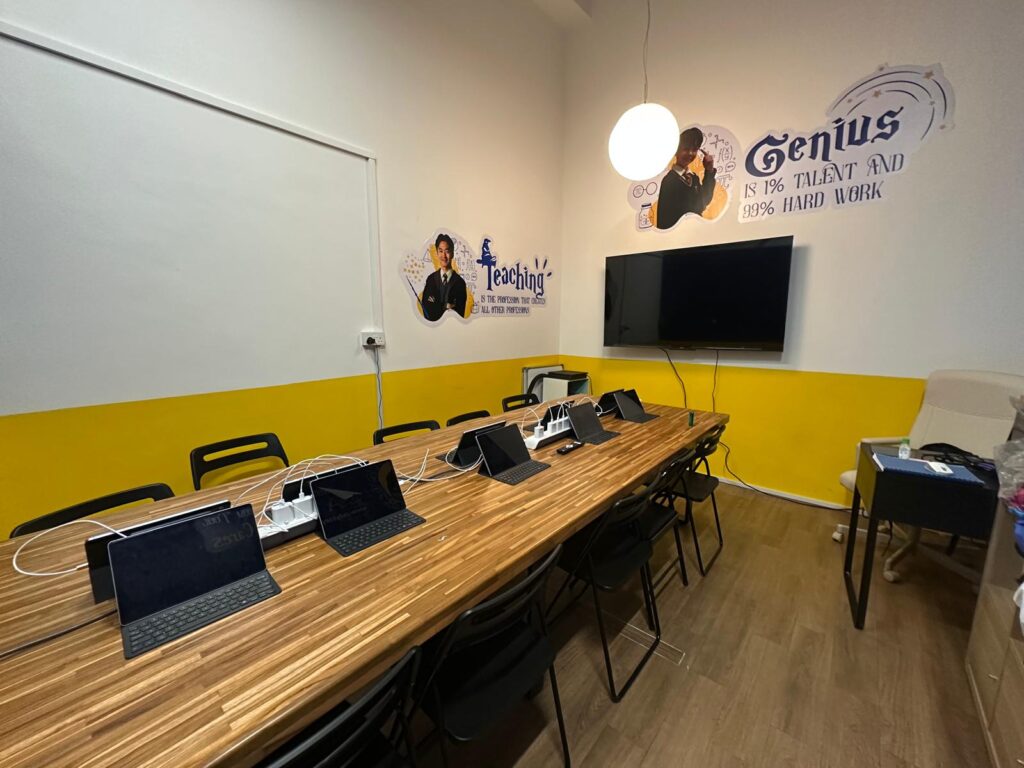
Sit in on a lesson first. We run a free trial class at our centre at Hexacube, 160 Changi Road — about three minutes from Eunos MRT. Message us on WhatsApp to book, or see class schedules and fees. See what we cover in this level.
Term 2 is the usual decision point
Not automatically, and not in Term 1 by default. Many students settle on their own once the novelty of secondary school wears off. The moment worth acting on is when the gap is conceptual rather than administrative — when the issue is that algebra has not clicked, rather than that homework is being left late.
There is a version of this decision that is worth resisting: booking tuition because other families have, before establishing whether there is anything to fix. A Secondary 1 student who is adjusting normally gains little from an extra ninety minutes a week, and may lose something — the expectation that difficulty is theirs to work through first. Support is most useful when it is aimed at something identified.
If you would rather test the water before committing to anything, our free Secondary 1 past-year papers come with worked video solutions, and running one under a real time limit at the kitchen table will tell you more than a term of report comments.
In practice, Term 2 is when most families reach a decision point, because that is when algebra becomes assumed knowledge. Waiting until the year-end examination usually means addressing three terms of accumulated material in a few weeks.
If you are weighing this up, the questions parents ask us most often cover timing, class sizes and what a first term typically looks like, and our schedules and fees page sets out the commitment plainly.
Diagnose, rebuild, then build fluency
Three things, in this order:
- Diagnose before prescribing. The presenting problem — “he is weak in algebra” — is rarely the actual problem. Frequently the gap sits further back, in negative numbers or in fraction fluency from primary school.
- Rebuild the missing layer, not the current topic. Teaching this week’s topic harder does not fix a foundation gap; it stacks on top of it.
- Build fluency deliberately. Understanding is necessary but not sufficient. Examination performance depends on fluency, and fluency is built by structured repetition.
That sequence is what our teaching curriculum is built around, and it is why a first lesson with us is largely diagnostic rather than instructional.
Often, yes — and it is worth saying so
Often, yes — and it is worth saying so plainly. If your child can work through a past-year Secondary 1 paper at around seventy per cent unaided, what they usually need is structured practice under timed conditions, not a new teacher. Free past-year papers with worked solutions will take a motivated student a long way.
Where outside help earns its place is when the gap is conceptual, when a student has stopped believing they are “a maths person”, or when the household simply does not have the hours to supervise the work. Those are different problems, and only the first is really about mathematics.
Prefer to learn at home? The online course for this level follows the same syllabus and the same sequence we teach in class, with worked video solutions your child can replay as often as they need. There is a free sample video for every level from Secondary 1 to JC2 if you would like to see the teaching first. You can also join us in person at our Eunos centre.
The work shows up two years later
Secondary 1 algebra is the foundation for everything that follows. Secondary 2 adds simultaneous equations and expands into functions. Secondary 3 splits into E-Math tuition and A-Math tuition, and the A-Math syllabus assumes algebraic fluency as a starting point rather than a goal. Students who arrive in Secondary 3 still translating slowly find that the pace leaves them behind quickly.
Put differently: the work done in Secondary 1 is rarely visible in the Secondary 1 result. It shows up two years later. Our secondary school math tuition pages set out how the levels connect.
Read next
For the transition itself, read the five things that change from P6 to Secondary 1. For what good support looks like, what Sec 1 math tuition should actually cover; for the content, the Secondary 1 syllabus topic by topic; for cost, Sec 1 math tuition rates in Singapore. If your child did well at PSLE and is still struggling, this explains why, and Secondary 2 math is what comes next. If you are still choosing a school, our list of secondary schools in Singapore covers each school’s programmes, streams and strengths. For practice, see Secondary 1 past-year exam papers. On studying this online, see Approximation and Estimation: A Secondary 1 Guide, Basic Geometry and Polygons: A Secondary 1 Guide and Linear Graphs and Simultaneous Linear Equations: A Sec 2 Guide.
Related guides
- PSLE Maths Paper 1 and Paper 2: How the Strategy Differs
- Reading the Signals in a Primary Maths Report
Frequently asked questions
Is Secondary 1 math harder than PSLE math?
It is different rather than uniformly harder. The individual questions are often more approachable than the most demanding PSLE problems, but the pace is faster and the notation is unfamiliar. Students who found PSLE comfortable can still struggle in Secondary 1, and this is common rather than alarming.
When do most parents start looking for Secondary 1 math tuition?
Term 2 is the most common point, because that is when algebra shifts from being a taught topic to being assumed knowledge. Some families start in Term 1 for continuity after PSLE; others wait until the mid-year examination gives them a clearer picture.
My child scored well in PSLE math. Why are they struggling now?
Usually because the method changed rather than the ability. Model drawing rewards visual reasoning; Secondary 1 rewards symbolic reasoning. A child who has not yet made that translation can look weaker than they are. It is one of the most recoverable gaps in the secondary curriculum.
How many hours a week should a Secondary 1 student spend on math?
For most students, around ninety minutes of focused practice a week outside school is enough in Secondary 1, provided it is genuinely focused. Quality of attention matters more than total hours at this level.
How much does Secondary 1 math tuition cost in Singapore?
As at mid-2026, group classes we see advertised commonly run between roughly S$200 and S$400 a month, varying with group size, contact time and tutor background. One-to-one is typically two to three times that. Convert monthly rates to an hourly figure before comparing, since session lengths differ more than headline prices suggest. Our own schedules and fees are published openly.
Do you offer one-to-one Secondary 1 tuition?
Most Secondary 1 difficulties — algebra translation, fluency gaps, foundation weaknesses — are common across students and are addressed efficiently in a small group. We generally recommend group classes at this level. One-to-one makes sense where a gap sits several years back, or where a specific learning need requires an adapted pace.
Do you teach subjects other than mathematics?
No. We teach mathematics only, from Primary 1 through to JC2. It is a deliberate limitation rather than a gap in the offering: it lets the teaching team specialise across every level of one syllabus instead of spreading across several subjects.
What if my child is significantly behind, not just struggling?
That is a different situation and needs a different plan. Where a student is carrying gaps from two or three years earlier, the work starts further back than the current syllabus and usually takes a term before school marks move. We would tell you that honestly at the first lesson rather than after a term.
Can we join partway through the school year?
Yes. Starting mid-term is usually better than waiting for a clean start if a real gap has been identified, because gaps compound across terms. The first lesson is diagnostic regardless of when a student joins, so the teaching begins from where they actually are.
A note on what we can and cannot promise: the patterns described here come from what we have seen in our own classes over the years. They are not a forecast for any individual student. Progress in mathematics is produced jointly — our teachers work hard for a student who is willing to put in the effort, with support at home. We do not promise grades.
Last reviewed July 2026. Syllabus details follow the Ministry of Education and SEAB published documents.