
One-to-one math tuition costs two to three times group rates and suits specific situations: unusual gaps, identified learning needs, or scheduling constraints. For typical difficulties at a given level, a small group is usually as effective and considerably cheaper. Hearing a classmate ask the same question is a benefit that individual sessions cannot reproduce.
Parents often assume one-to-one is simply the better product, purchased when affordable. That is not what we observe, and it is worth setting out the trade-off honestly — including where group teaching genuinely loses.
It is the more expensive product, and for a specific set of situations it is worth every dollar. But the assumption that price tracks effectiveness breaks down here in a way worth understanding, because the things a small group provides are not merely cheaper substitutes for individual attention — some of them cannot be bought individually at all.
The honest framing is that these are different products suited to different problems, not a premium and a budget version of the same thing.
What one-to-one does well
- Unusual gaps. A student whose difficulty sits several years back needs a pace no group can accommodate.
- Identified learning needs. Where a specific difficulty requires adapted instruction, individual attention is not a luxury.
- Scheduling. Sometimes the honest reason, and a legitimate one.
- Anxiety. A student who will not speak in front of peers may need to rebuild confidence privately first.
What a small group does well
- Normalises difficulty. Hearing another student ask the same question is genuinely therapeutic for a child who assumed they were the only one lost.
- Exposes varied methods. Watching a peer solve something differently teaches flexibility that one-to-one rarely provides.
- Builds examination realism. Working alongside others under time approximates the actual conditions better.
- Costs substantially less — which for many families means sustaining support for the full year rather than one term.
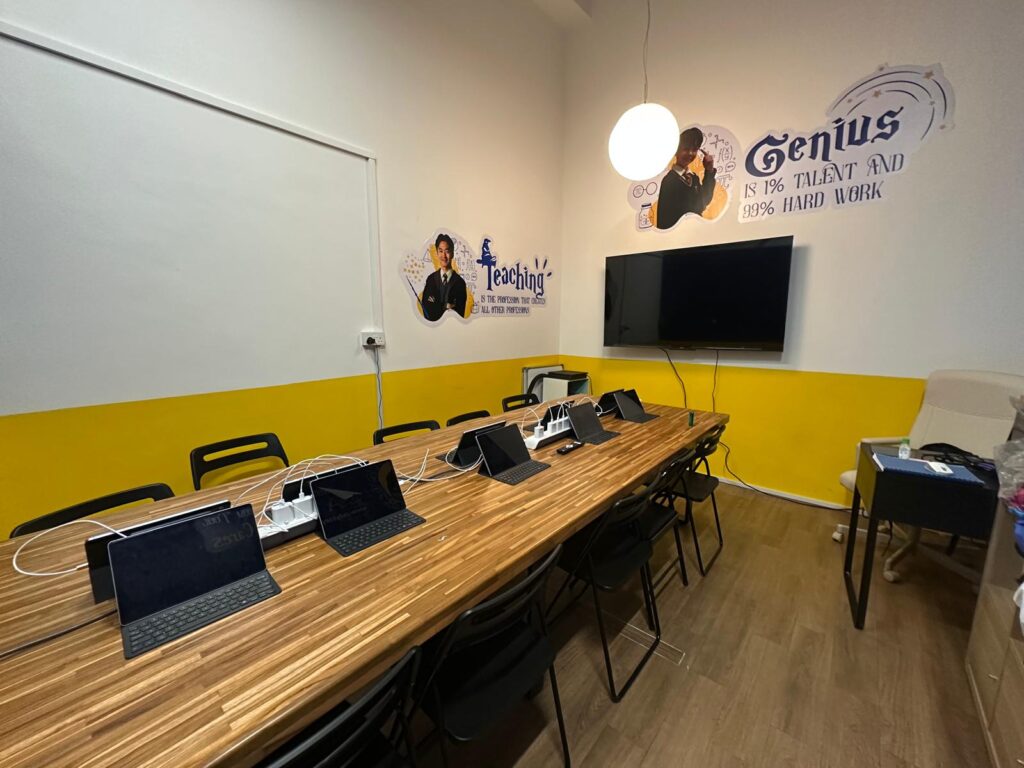
Sit in on a lesson first. We run a free trial class at our centre at Hexacube, 160 Changi Road — about three minutes from Eunos MRT. Message us on WhatsApp to book, or see class schedules and fees.
This one is consistently underrated by parents and consistently reported by students. A teenager who believes they are the only person in their cohort who does not understand something behaves very differently from one who has heard a classmate ask the same question. The second student asks more, guesses less, and recovers faster — and no amount of individual attention reproduces that effect.
A practical test for deciding
A practical test: is the difficulty typical for the level, or unusual for it? Secondary 1 algebra translation, Primary 5 ratio, Secondary 3 A-Math fluency — these are common, and a small group handles them efficiently because the tutor has taught the same gap many times.
A student two years behind, or one with an identified learning difficulty, is a different case.
The middle option is often the sensible one
Often the most sensible one. A small group class combined with our online courses lets a student revisit specific topics as often as needed without paying individual rates for repetition — which is what much one-to-one time actually gets spent on.
Our published fees let you compare the options directly, and the FAQ covers how we assess which format suits a particular student.
What counts as small enough
The number matters less than the mechanism. The practical question is whether the tutor sees every student’s written work during a session — not their answers, their working.
In a group where that happens, a student who has quietly adopted a wrong method gets caught within a week. In a group where it does not, the same student can practise the wrong method for a term and arrive at the examination having rehearsed the error thoroughly.
Ask the question that way rather than asking for a headcount, and the answer is more revealing.
Sharing a session with a friend
Parents often propose sharing one-to-one sessions between two children to split the cost. It can work, with one caveat worth knowing: it only works if both children have a similar gap.
Two students at the same level with different difficulties get roughly half a lesson each rather than a shared one. Where the gaps genuinely match, it is an efficient arrangement and often better than either child alone, because they can explain things to each other.
Prefer to learn at home? Our online math courses follow the same syllabus and the same sequence we teach in class, with worked video solutions your child can replay as often as they need. You can also join us in person at our Eunos centre.
Read next
On cost, see our honest breakdown of math tuition fees and Sec 1 tuition rates. On choosing a provider, how to choose a math tuition centre and the nine criteria. On the first visit, what a trial lesson should involve. If you are choosing a school as well as a tuition centre, our list of primary schools in Singapore and list of secondary schools in Singapore are the companion directories. On studying this online, see Unlimited Replays: The Most Underrated Part of an Online Math Course, What 24/7 Access to a Math Course Actually Changes and Inside the Secondary 1 Online Math Course.
Related guides
Frequently asked questions
Is one-to-one tuition worth the extra cost?
For typical level-specific difficulties, usually not — a small group addresses them as effectively for considerably less. It becomes worth the premium for unusual gaps, identified learning needs, or where scheduling leaves no alternative.
Can we start one-to-one and move to a group later?
That sequence often works well: individual attention to close a specific gap, then a group for ongoing consolidation and examination practice. It is usually more economical than the reverse.
Does my child get less attention in a group?
Less individual airtime, yes. Whether that means less useful attention depends on group size and on the tutor. In a small group a capable tutor sees every student’s work each session; in a large one they cannot.
Can two children share a one-to-one session?
It can work, with one caveat: both children need a similar gap. Two students at the same level with different difficulties get roughly half a lesson each rather than a shared one. Where the gaps genuinely match, they often explain things to each other usefully.
What group size counts as small?
The number matters less than the mechanism. The useful question is whether the tutor sees every student’s written working during a session, not just their answers. Where that happens, a wrong method is caught within a week rather than rehearsed for a term.
Does one-to-one suit anxious students better?
Often initially, yes. A student who will not speak up in front of peers may need to rebuild confidence privately first. That said, moving into a small group later has real value, because hearing another student ask the same question is genuinely reassuring.
Which format suits examination preparation better?
A small group, usually. Working alongside others under timed conditions approximates the actual examination environment more closely, and watching a peer solve something differently teaches flexibility that individual sessions rarely provide.
A note on what we can and cannot promise: the patterns described here come from what we have seen in our own classes over the years. They are not a forecast for any individual student. Progress in mathematics is produced jointly — our teachers work hard for a student who is willing to put in the effort, with support at home. We do not promise grades.
Last reviewed July 2026. Syllabus details follow the Ministry of Education and SEAB published documents.