
Copying AI solutions produces completed homework, unchanged classwork and an exam result that surprises everyone. The gap is invisible precisely because the work looks fine.
The delayed failure
A student copying solutions submits correct homework all term. Nothing in the feedback loop signals a problem, because the visible output is good.
The gap appears in the first assessment where the tool is unavailable, and by then months of practice time have gone.
Why students do it
Rarely out of dishonesty. Usually because they are stuck, it is late, the homework is due, and the tool resolves the immediate problem.
Treating it as a discipline issue tends to miss this. A student copying every night is usually a student who cannot do the work, and that is the thing to address.
Spotting it
Homework quality well above classwork quality is the clearest signal.
Solutions that use methods the class has not been taught.
An inability to explain their own submitted work, or to do a similar question unaided.
Signals worth watching for:
- Homework noticeably stronger than classwork
- Methods appearing that the class has not covered
- Cannot explain their own submitted working
- Cannot do a similar question a day later
- Test results well below homework standard
What to do about it
Address the cause rather than the behaviour. If the work is too hard, that is a teaching problem, and punishing the copying leaves the student stuck as well as in trouble.
Set the expectation that any submitted work must be explainable. That is a fair standard, it is easy to test, and it makes the point without an argument about technology.
What lessons at Odyssey are actually like
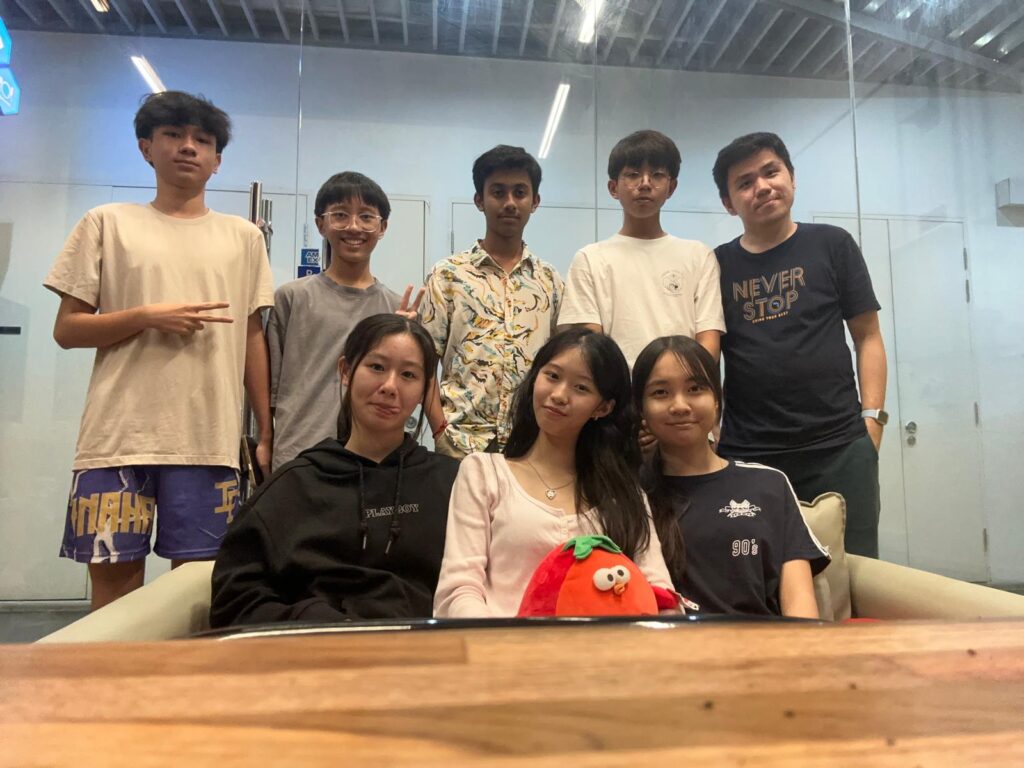
A student describes the experience in her own words. She is in secondary school, and the teaching she describes is what we do at primary level too. More are on Odyssey Math TV.
Where Odyssey fits
Everything here applies across maths tuition at Odyssey, including secondary maths tuition.
Because we review homework in the following lesson, a gap between submitted work and what a student can actually do tends to surface quickly rather than at the exam.
We teach maths only, in small classes at Hexacube, 160 Changi Road #01-02, about three minutes from Eunos MRT. See the primary and secondary programmes, our MOE-aligned curriculum, schedules and fees, or the tutors who teach. Free video solutions to past-year papers are on Odyssey Math TV.
It is also why a difficulty in one year is so often a leftover from an earlier one. Because our curriculum spans Primary 1 through Primary 6, we can go back to the genuine cause rather than treating the symptom in front of us. A child struggling with Primary 5 fractions frequently has a Primary 3 equivalence problem, and no amount of Primary 5 practice will resolve it.
Start with the free trial lesson. We use it to work out where the difficulty really sits, and we will say so plainly — including if we think the sensible course is to wait a term and watch. Parents generally find that more useful than a confident sales answer. Get in touch or WhatsApp +65 8512 6882.
What we describe here comes from teaching this syllabus in our own classes since 2012. It is not a forecast for any individual child: progress is produced jointly, by a student willing to do the work with support at home. We do not promise grades. Topics follow the MOE primary mathematics syllabus — check the current syllabus on the MOE website for the definitive version, and see our curriculum page for how we teach it.
Related reading
- AI-Generated Maths Worksheets: A Verification Checklist
- Why Students Should Ask AI for Hints Before Answers
- Calculator Mistakes in Secondary Maths
- Can AI Understand the Model Method?
-end
From our online course guides
Frequently asked questions
How can I tell if my child is copying solutions?
Ask them to do a similar question the next day unaided, and to explain a piece of their own submitted working. Both are quick and conclusive.
Should copying be treated as cheating?
It is worth naming honestly, but the more useful response is usually to find out why the work was too hard in the first place.
Why does it take so long to notice?
Because homework looks correct and classwork is often not scrutinised closely. The first clear signal is frequently an exam.
What standard should I set?
That any submitted work must be explainable. It is fair, testable, and avoids an argument about the technology itself.