
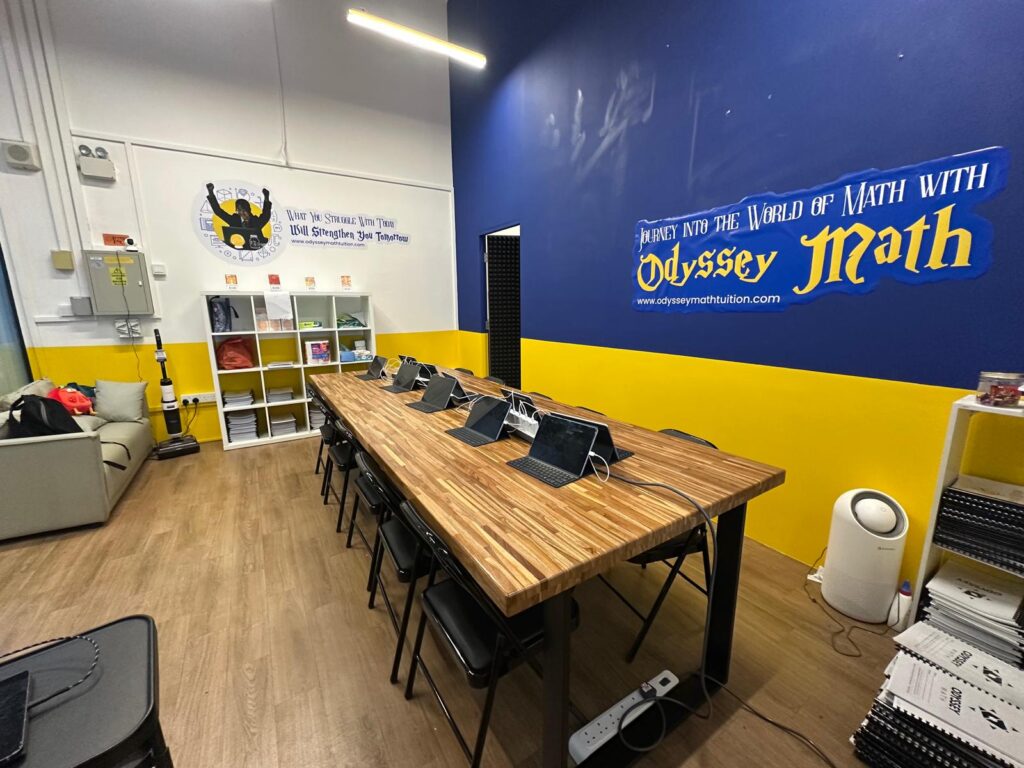
Rates of Change and Connected Rates is usually met around Secondary 4 A-Math — though schools sequence topics differently — and is covered in Odyssey Math Tuition’s online math course for that level, with recorded video lessons, a question bank, topical practice and a topical test. Most marks lost here come from execution errors rather than misunderstanding, which is why targeted practice works.
What rates of change and connected rates actually asks of a student
Connected rates of change ask how fast one quantity varies when another, related to it, is changing. A balloon inflates, water drains from a cone, a shadow lengthens.
The mathematics is the chain rule. The difficulty is identifying which rate is given, which is wanted, and what equation connects the two quantities — and that setup is where almost all the marks are won or lost.
What the topic assumes you already have
Most difficulty in this topic is not caused by the topic itself. It is caused by something earlier that never became fluent. Check these first:
- Differentiation including the chain rule, entirely fluent
- Volume and surface area formulae from memory
- Comfort with rate notation and what each symbol means
- Algebraic substitution and rearrangement
If any of these is shaky, repair it before going further. Working on new material while a prerequisite is unstable is how students spend hours and move nothing.
Where marks are actually lost
- Writing the wrong chain of derivatives, so the given rate cannot be used
- Substituting the particular value before differentiating rather than after
- Losing a negative sign when a quantity is decreasing
- Using a formula with two variables without eliminating one first
- Not stating units, or giving them inconsistently
Most of these are execution errors rather than gaps in understanding, which is encouraging: they respond to practice and to keeping a written record of the mistakes you personally repeat.
A revision approach that works
- Write down what is given and what is wanted, in rate notation, before anything else.
- Differentiate first, substitute the particular value last. Always.
- Watch the sign: draining, cooling and shrinking are negative rates.
- State units in the final answer as a matter of routine.
How the Secondary 4 A-Math course covers it
In the Secondary 4 A-Math online course this topic follows the same shape as every other: a recorded explanation, a question bank with answers worked through rather than printed, topical practice, and a topical test. Lessons are recorded personally by our founder, Mr. Justin Tan, and the course follows our own curriculum, aligned to the MOE syllabus.
The courses also include past-year school examination papers with worked answers, which shows how a topic is actually examined rather than how it is taught. Access is 24 hours a day with unlimited replays, and every online course carries a 7-day money-back guarantee.
Where this sits in the wider syllabus
For the year as a whole, see our guide to this stage. For the subject in context, this guide and this one cover what comes before and after.
Syllabus details follow Ministry of Education and SEAB published documents. Course details and prices are as published at the time of writing — check the course pages for current information. We do not promise grades.
Read next
Related reading on studying maths online: Inside the Secondary 4 E-Math Online Math Course, Inside the Secondary 4 A-Math Online Math Course, Differentiation: A Secondary 4 A-Math Revision Guide, Congruence and Similarity: A Secondary 2 Revision Guide, What Is Inside the Maths Question Bank. On choosing a school at this stage, see our list of secondary schools in Singapore.
More on getting the most from your maths
- How Many Hours of Maths Tuition Does a Student Need?
- How Parents Should Use Worked Solutions at Primary Level
Frequently asked questions
What does rates of change and connected rates cover at Secondary 4 A-Math?
Connected rates of change ask how fast one quantity varies when another, related to it, is changing. A balloon inflates, water drains from a cone, a shadow lengthens.…
What should my child revise before this topic?
The prerequisites listed above. Most difficulty traces back to an earlier skill that never became fluent rather than to the topic itself.
Where do students lose the most marks?
Almost always in execution rather than understanding — sign errors, answering a different question from the one asked, or skipping the sketch.
Is this topic in the online course?
Yes. It is covered in the Secondary 4 A-Math online math course with video lessons, a question bank, topical practice and a topical test.
Can we access just this topic?
Yes. The courses are self-paced and non-linear, so a student can go straight to one topic without working through the rest.
Is there a trial period?
All online courses carry a 7-day money-back guarantee. The terms and conditions set out how it works.
Last reviewed July 2026. Syllabus details follow the Ministry of Education and SEAB published documents.