
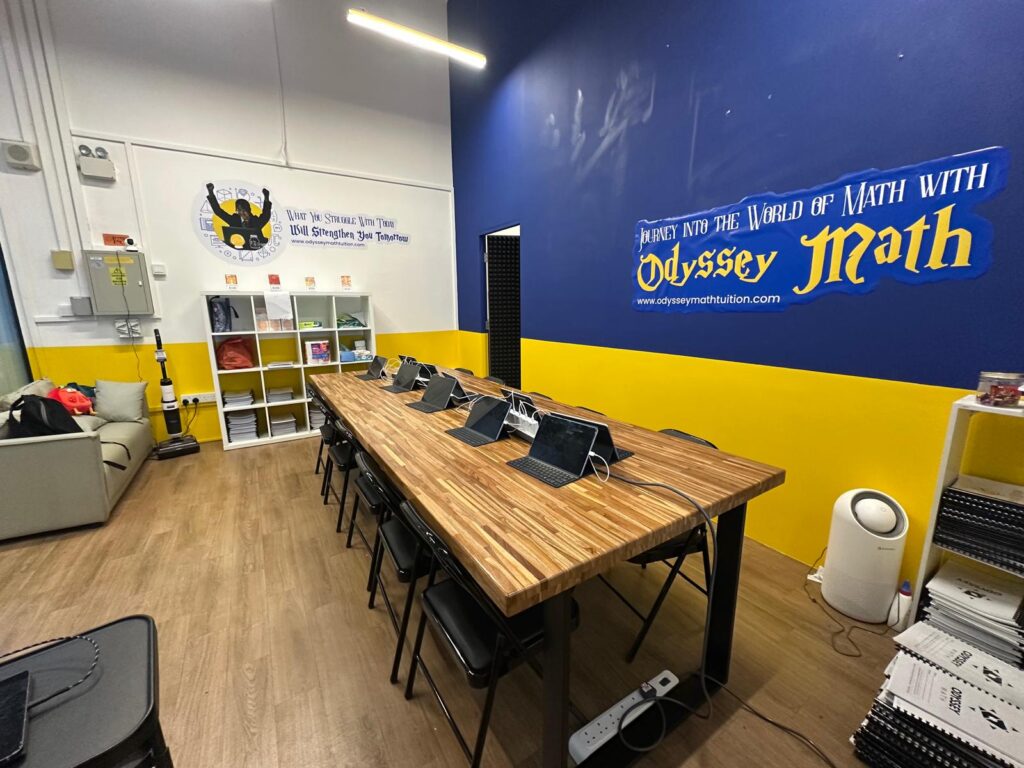
Properties of Circles is usually met around Secondary 3 E-Math — though schools sequence topics differently — and is covered in Odyssey Math Tuition’s online math course for that level, with recorded video lessons, a question bank, topical practice and a topical test. Most marks lost here come from execution errors rather than misunderstanding, which is why targeted practice works.
What properties of circles actually asks of a student
Circle properties are a set of relationships between angles, chords and tangents that hold in every circle. The topic is unusual in the E-Math syllabus because it is almost entirely about recognition rather than calculation.
The arithmetic is usually trivial. The difficulty is seeing which property applies to the diagram in front of you, and then saying so — marks are awarded for the reason given, not only the number produced.
What the topic assumes you already have
Most difficulty in this topic is not caused by the topic itself. It is caused by something earlier that never became fluent. Check these first:
- Angles in a triangle and on a straight line
- Isosceles triangle properties, which appear constantly with radii
- Comfort annotating a diagram
- Basic algebra for setting up angle equations
If any of these is shaky, repair it before going further. Working on new material while a prerequisite is unstable is how students spend hours and move nothing.
Where marks are actually lost
- Giving a correct answer with no reason stated, losing the reasoning marks
- Assuming a triangle is isosceles without justifying it from equal radii
- Confusing the angle at the centre with the angle at the circumference
- Missing that a tangent meets a radius at a right angle
- Working from a badly drawn diagram instead of marking it up first
Most of these are execution errors rather than gaps in understanding, which is encouraging: they respond to practice and to keeping a written record of the mistakes you personally repeat.
A revision approach that works
- Write each property on a card with a sketch. Recognition is the entire skill.
- Mark every radius, right angle and equal angle on the diagram before calculating.
- Practise stating reasons in full sentences; examiners award them.
- Do questions where several properties combine, which is how they are examined.
How the Secondary 3 E-Math course covers it
In the Secondary 3 E-Math online course this topic follows the same shape as every other: a recorded explanation, a question bank with answers worked through rather than printed, topical practice, and a topical test. Lessons are recorded personally by our founder, Mr. Justin Tan, and the course follows our own curriculum, aligned to the MOE syllabus.
The courses also include past-year school examination papers with worked answers, which shows how a topic is actually examined rather than how it is taught. Access is 24 hours a day with unlimited replays, and every online course carries a 7-day money-back guarantee.
Where this sits in the wider syllabus
For the year as a whole, see our guide to this stage. For the subject in context, this guide and this one cover what comes before and after.
Syllabus details follow Ministry of Education and SEAB published documents. Course details and prices are as published at the time of writing — check the course pages for current information. We do not promise grades.
Read next
Related reading on studying maths online: Polynomials and Partial Fractions: A Sec 3 A-Math Guide, Circles in Coordinate Geometry: A Sec 3 A-Math Guide, Pythagoras and Trigonometry Together: A Sec 3 E-Math Guide, Screen-Based Learning and Whether Anything Is Retained, Probability of Single Events: A Secondary 2 Guide, The 7-Day Money-Back Guarantee, Explained. On choosing a school at this stage, see our list of secondary schools in Singapore.
More on getting the most from your maths
Frequently asked questions
What does properties of circles cover at Secondary 3 E-Math?
Circle properties are a set of relationships between angles, chords and tangents that hold in every circle. The topic is unusual in the E-Math syllabus because it is almost entirely about recognition rather than calculation.…
What should my child revise before this topic?
The prerequisites listed above. Most difficulty traces back to an earlier skill that never became fluent rather than to the topic itself.
Where do students lose the most marks?
Almost always in execution rather than understanding — sign errors, answering a different question from the one asked, or skipping the sketch.
Is this topic in the online course?
Yes. It is covered in the Secondary 3 E-Math online math course with video lessons, a question bank, topical practice and a topical test.
Can we access just this topic?
Yes. The courses are self-paced and non-linear, so a student can go straight to one topic without working through the rest.
Is there a trial period?
All online courses carry a 7-day money-back guarantee. The terms and conditions set out how it works.
Last reviewed July 2026. Syllabus details follow the Ministry of Education and SEAB published documents.