
Reviewing a wrong answer usefully means identifying which of four things went wrong — reading, method, execution or presentation — because each needs a different response.
Why most review changes nothing
The usual review is to look at the correct solution, understand it, and move on. That produces the feeling of learning without much of the substance, because understanding someone else’s solution is far easier than producing your own.
Worse, it hides the cause. A student who misread the question and a student who did not know the method both end up nodding at the same worked solution.
The four causes
Reading: the question was misunderstood. Method: the approach chosen could not work. Execution: the approach was right and the arithmetic slipped. Presentation: the mathematics was right and the marks were lost anyway.
These need different remedies. More practice questions help execution and do almost nothing for reading or presentation.
Doing the review properly
Before looking at the solution, have your child say what they think went wrong. Being right about the cause is itself the skill.
Then re-attempt the question from scratch, without the solution visible. If it can be done unaided, the gap was execution; if not, it was method or reading.
For every wrong answer, record:
- The topic it belonged to
- Which of the four causes applied
- Whether it could be re-done unaided afterwards
- Whether the same cause has appeared before
Keeping a record
Log the topic and the cause for every wrong answer. After a few weeks the pattern is obvious, and it is usually narrower than expected — two or three topics and one recurring habit.
That list is the revision plan. It is far more useful than working through a book front to back, because it directs the available time at the specific things costing marks rather than spreading it evenly over material the child has already secured. Most families are surprised by how short the list turns out to be once it is written down.
What lessons at Odyssey are actually like
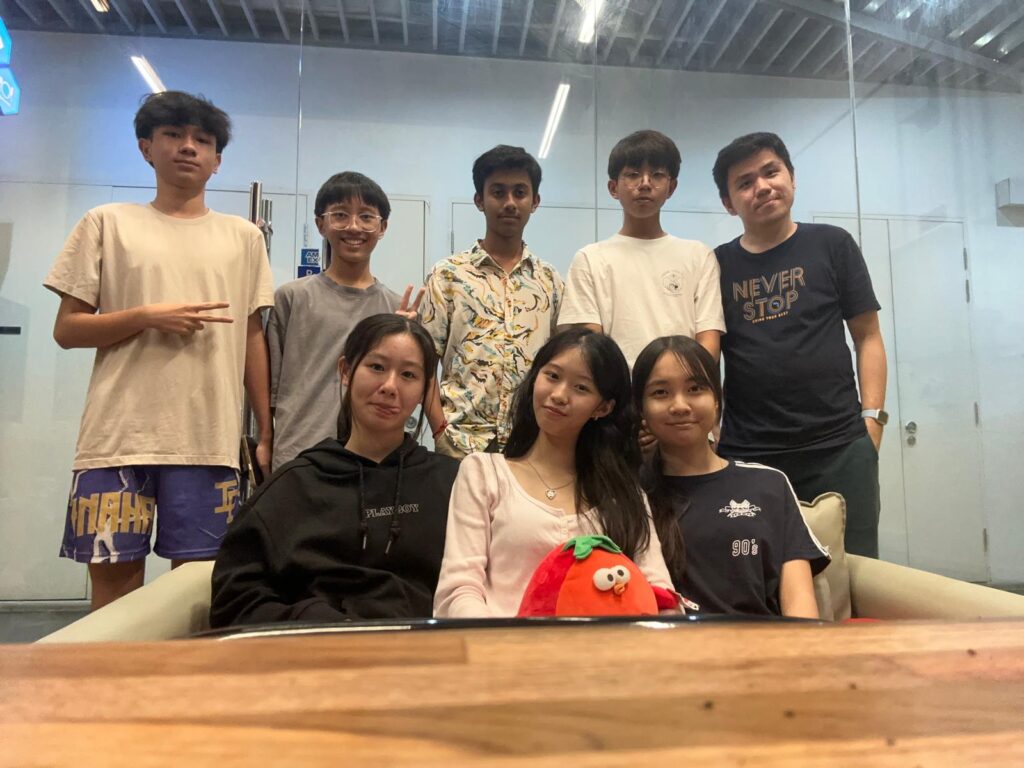
What the teaching looks like from a student’s side. This is a secondary student — primary lessons follow the same approach at an age-appropriate pace. More are on Odyssey Math TV.
Where Odyssey fits
PSLE preparation runs through our Primary 6 classes, part of the full maths tuition programme.
Our topical tests are used this way rather than as scores to be reported: the point is the diagnosis, not the mark.
We teach maths only, in small classes at Hexacube, 160 Changi Road #01-02, about three minutes from Eunos MRT. See the primary and secondary programmes, our MOE-aligned curriculum, schedules and fees, or the tutors who teach. Free video solutions to past-year papers are on Odyssey Math TV.
Because each year assumes the last, we teach the primary levels as one continuous sequence. Our MOE-aligned curriculum covers Primary 1 through Primary 6, so repair happens at the source rather than at the surface. In practice that often means spending a lesson on something from two years ago in order to fix what is failing today.
A free trial class costs you an hour and tells you where the real gap is. For most families that is more useful than another assessment book, because the problem is rarely a shortage of practice and usually a specific misunderstanding nobody has found yet. Book one here or WhatsApp +65 8512 6882.
What we describe here comes from teaching this syllabus in our own classes since 2012. It is not a forecast for any individual child: progress is produced jointly, by a student willing to do the work with support at home. We do not promise grades. Topics follow the MOE primary mathematics syllabus — check the current syllabus on the MOE website for the definitive version, and see our curriculum page for how we teach it.
Related reading
- AI-Generated Maths Worksheets: A Verification Checklist
- Calculator Mistakes in Secondary Maths
- From G2 and G3 Fundamentals to Exam Application
- Group or One-to-One Maths Tuition at Primary Level?
- PSLE Math: A Complete Guide for Singapore Parents
-end
Frequently asked questions
How long should reviewing a paper take?
Often longer than sitting it. A paper reviewed properly is worth several papers sat and filed away.
Should my child redo every wrong question?
Redo them unaided a day or two later. Redoing immediately with the solution fresh tests memory rather than understanding.
What if the same mistake keeps recurring?
Then it is a habit rather than a slip, and it needs a specific rule to interrupt it — a checking step, a written unit, a re-read.
Is it worth keeping old papers?
The papers matter less than the log of causes. That is the thing worth keeping.