
Knowing a method and recognising when to use it are different skills. Most students who plateau have the content and lack the application, which needs a different kind of practice.
The plateau
A familiar pattern: a student can do every exercise in the chapter and still underperform on the paper. Parents conclude the content is not known. Usually it is.
What is missing is the step before the method — reading an unfamiliar question and deciding what kind of problem it is.
Why chapter exercises do not build it
A chapter exercise announces the topic. The decision has been made for the student, so the skill being tested is execution.
Exams remove the label deliberately. That is the entire difference, and it explains why chapter fluency and exam performance can diverge so sharply.
Signs a student is stuck at fundamentals:
- Strong on chapter exercises, weak on mixed papers
- Asks “which topic is this?” when shown a question
- Can execute a method but not choose one
- Multi-topic questions abandoned early
- Marks fall when questions are worded rather than symbolic
What builds application
Mixed sets where the topic is not named, so the student must classify before solving.
Past-year papers, which are interleaved by construction and pitched at the right level.
Questions that combine two topics, which is where most O-Level marks are actually lost.
Working backwards from the mark allocation: a five-mark question is not a one-step question, and noticing that shapes the approach.
A realistic sequence
Secure the method with chapter work. Then move to mixed sets. Then to full papers. The common error is staying in the first phase because performance there is comfortable.
For students in the last year, the shift should happen early enough that there is time to act on what the papers reveal.
What lessons at Odyssey are actually like
Here is a student talking about what studying with us is actually like. She is at secondary level; the teaching method is the one we use throughout, adjusted to the age. More are on Odyssey Math TV.
Where Odyssey fits
We teach secondary maths tuition at our Eunos centre — see also our maths tuition programme. Students from Secondary 1 to JC2 can also work through the same material in our online maths courses.
Our secondary classes work mixed and past-paper questions alongside topical teaching, and every enrolled student also gets the online course for their level to revisit methods between lessons.
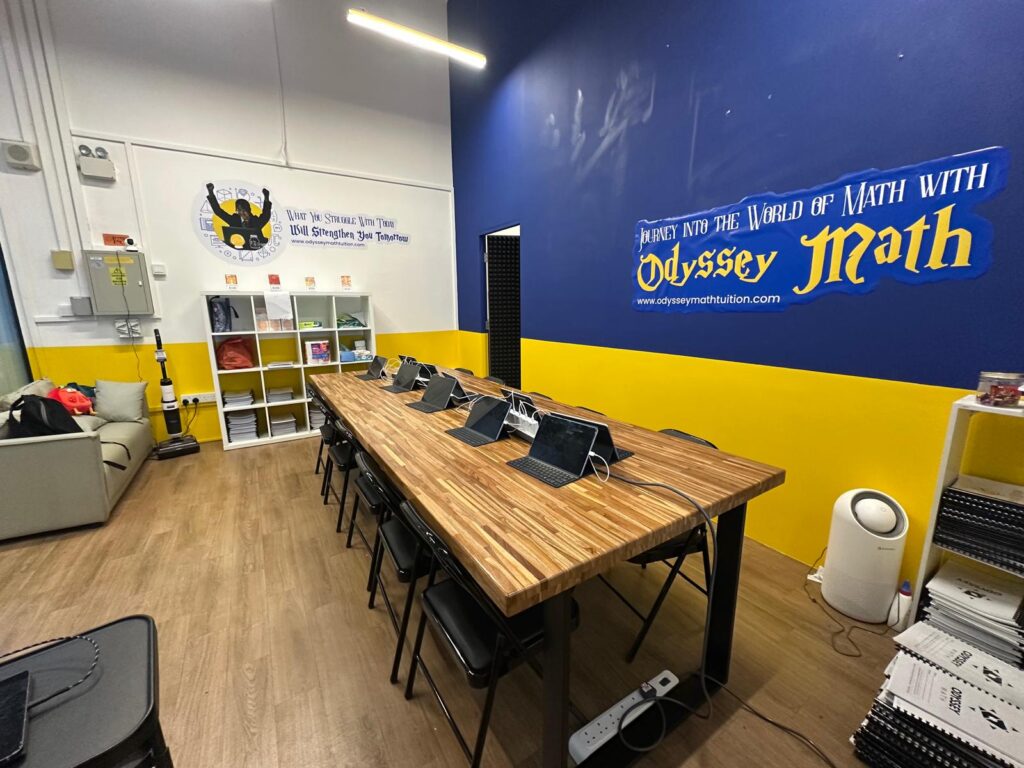
We teach maths only, in small classes at Hexacube, 160 Changi Road #01-02, about three minutes from Eunos MRT. See the primary and secondary programmes, our MOE-aligned curriculum, schedules and fees, or the tutors who teach. Free video solutions to past-year papers are on Odyssey Math TV.
It is also why a difficulty in one year is so often a leftover from an earlier one. Because our curriculum spans Primary 1 through Primary 6, we can go back to the genuine cause rather than treating the symptom in front of us. A child struggling with Primary 5 fractions frequently has a Primary 3 equivalence problem, and no amount of Primary 5 practice will resolve it.
Start with the free trial lesson. We use it to work out where the difficulty really sits, and we will say so plainly — including if we think the sensible course is to wait a term and watch. Parents generally find that more useful than a confident sales answer. Get in touch or WhatsApp +65 8512 6882.
What we describe here comes from teaching this syllabus in our own classes since 2012. It is not a forecast for any individual child: progress is produced jointly, by a student willing to do the work with support at home. We do not promise grades. Topics follow the MOE primary mathematics syllabus — check the current syllabus on the MOE website for the definitive version, and see our curriculum page for how we teach it.
Related reading
- Interleaving: Why Mixed Maths Practice Beats Topic Blocks
- A JC1 Holiday Revision Plan for H2 Maths
- The Model Method at PSLE Level: When It Still Earns Marks
- Notation Errors in H2 Mathematics
-end
From our online course guides
- Inside the Junior College 1 H2 Mathematics Online Math Course
- Inside the Junior College 2 H2 Mathematics Online Math Course
Frequently asked questions
My child does well in class but not in exams. Why?
Usually because class work names the topic and exams do not. The missing skill is recognition, not knowledge.
When should past papers start?
Once the syllabus is largely covered. Earlier than that they mostly measure what has not been taught.
Are mixed sets better than chapter exercises?
They serve different purposes. Chapter work builds the method; mixed work builds the decision. Both are needed, in that order.
How do multi-topic questions differ?
They require connecting two areas, which is where most marks are lost at O-Level and where chapter practice gives no preparation at all.