
Practising one topic at a time removes the hardest step — working out what kind of question it is. Mixed practice restores it, which is what exams actually test.
The hidden help in a topic block
A worksheet headed “Fractions” has already answered the first question a student would face in an exam: what kind of problem is this?
That is not a small help. In an exam, recognising the type is frequently harder than executing the method, and blocked practice never exercises it.
What interleaving does
Mixing topics forces a decision before every question. It feels harder and performance in the session drops, which is why students and parents dislike it.
But the transfer to exam conditions is much better, because exam conditions are interleaved by definition.
When to use which
Blocked practice while a topic is being learned. There is no point mixing questions before the method is understood.
Interleaved practice once it is understood, and increasingly as exams approach. The switch is usually made too late or not at all.
A simple progression for any topic:
- Learn the method with blocked practice
- Consolidate with more of the same
- Mix with two or three related topics
- Mix with unrelated topics, unlabelled
- Full past papers, which interleave everything
Making mixed sets at home
Take questions from several past topics and shuffle them. Past-year papers are already interleaved, which is part of their value.
Do not label the questions. The moment a set is labelled by topic, the benefit disappears.
Keep the sets short. Eight mixed questions attempted properly, with the student deciding the approach for each, is worth more than thirty from a single chapter. The cognitive work sits in the decision rather than in the repetition, so volume adds much less here than it does when a method is first being drilled.
Expect the marks to dip when you first switch. Parents sometimes read that dip as evidence the approach is failing and revert to topic blocks, which is precisely the wrong conclusion — the earlier score was inflated by the labelling, not by greater competence.
What lessons at Odyssey are actually like
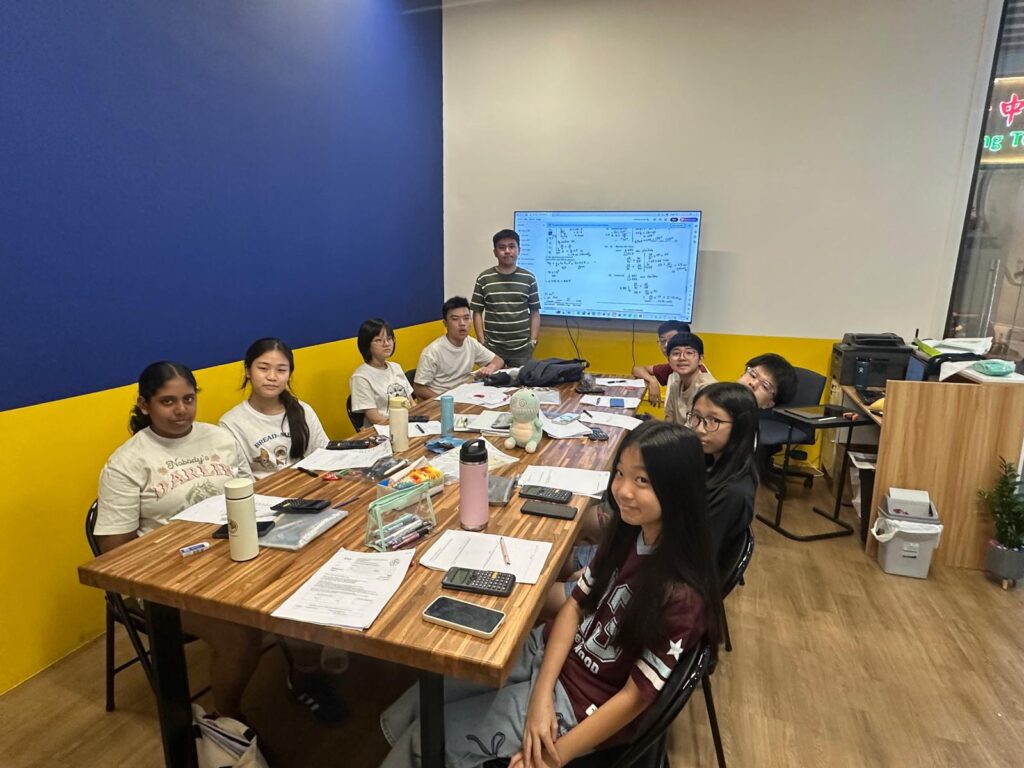
What the teaching looks like from a student’s side. This is a secondary student — primary lessons follow the same approach at an age-appropriate pace. More are on Odyssey Math TV.
Where Odyssey fits
Everything here applies across maths tuition in Singapore, including primary maths tuition. Students from Secondary 1 to JC2 can also work through the same material in our online maths courses.
Our topical tests are followed by mixed review precisely so students practise recognising question types, not just executing methods.
We teach maths only, in small classes at Hexacube, 160 Changi Road #01-02, about three minutes from Eunos MRT. See the primary and secondary programmes, our MOE-aligned curriculum, schedules and fees, or the tutors who teach. Free video solutions to past-year papers are on Odyssey Math TV.
Because each year assumes the last, we teach the primary levels as one continuous sequence. Our MOE-aligned curriculum covers Primary 1 through Primary 6, so repair happens at the source rather than at the surface. In practice that often means spending a lesson on something from two years ago in order to fix what is failing today.
A free trial class costs you an hour and tells you where the real gap is. For most families that is more useful than another assessment book, because the problem is rarely a shortage of practice and usually a specific misunderstanding nobody has found yet. Book one here or WhatsApp +65 8512 6882.
What we describe here comes from teaching this syllabus in our own classes since 2012. It is not a forecast for any individual child: progress is produced jointly, by a student willing to do the work with support at home. We do not promise grades. Topics follow the MOE primary mathematics syllabus — check the current syllabus on the MOE website for the definitive version, and see our curriculum page for how we teach it.
Related reading
- What a PSLE AL Score Actually Measures
- What to Bring to a Maths Diagnostic Lesson
- When an Online Maths Course Is Not the Right Fit
- When to Start Primary Maths Tuition
-end
From our online course guides
Frequently asked questions
Why does my child do worse on mixed practice?
Because it is harder — it adds the step of identifying the question type. Lower in-session performance with better exam transfer is the expected pattern.
When should we switch from topic practice to mixed?
Once the method is understood. Mixing before that is unproductive; staying blocked afterwards is the commonest mistake.
Are past papers interleaved?
Yes, inherently, which is a large part of why they are useful once the syllabus is largely covered.
Should mixed sets be labelled by topic?
No. Labelling removes exactly the skill the mixing was meant to build.