
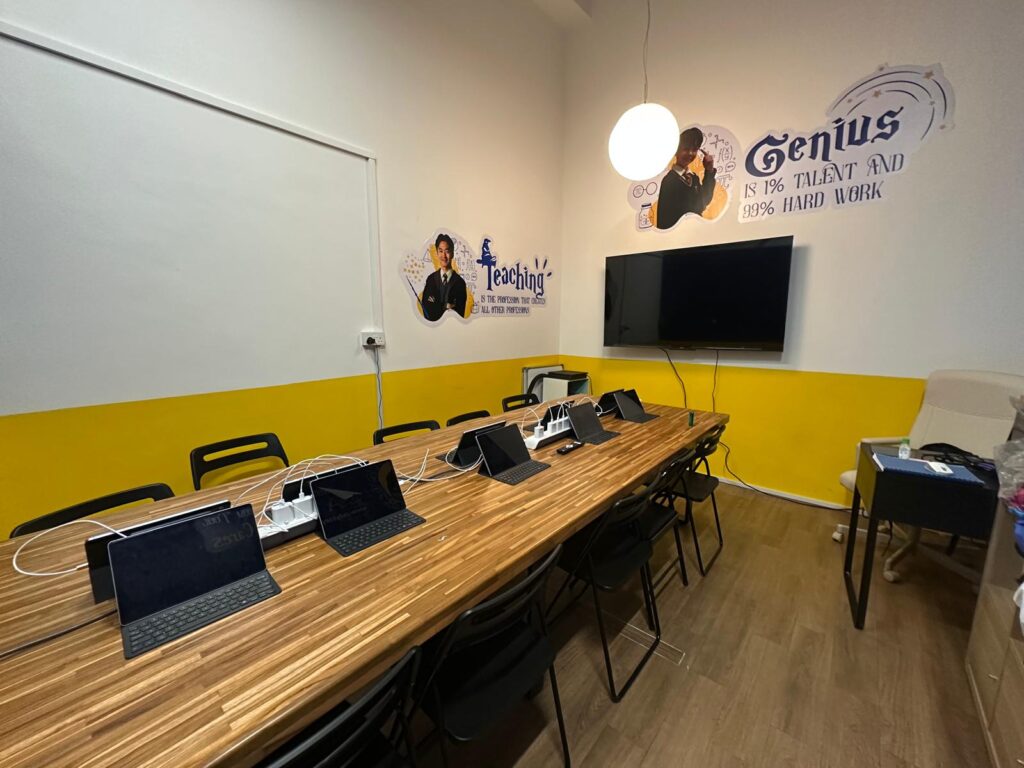
A diagnostic lesson is more useful when the tutor can see recent marked work. Bringing the last few tests, including the wrong answers, is worth more than any description of the problem.
What actually helps a tutor
Marked work, especially wrong answers with the working still visible. That is the single most informative thing a parent can provide, because it shows how the student thinks rather than what they scored.
Recent tests rather than a curated selection. The messy ones carry more information than the good ones.
Worth bringing:
- The last few marked tests, including the bad ones
- Any work where the working is still visible
- The school textbook or workbook currently in use
- A note of when the difficulty started
- What has already been tried at home
What to tell us
When the difficulty started, and what changed around then. A drop that coincides with a change of school, teacher or topic narrows the search considerably.
What has already been tried, so we do not repeat something that failed.
Whether the student is anxious about the subject, because that changes how the first few lessons should be run.
What not to worry about
Preparing the child. A diagnostic lesson works better when it shows the ordinary state of things rather than a rehearsed version.
Poor results. They are the useful data. A parent who brings only the good papers has removed the information we need.
What you should get out of it
A specific view of what is causing the difficulty, expressed as a topic or a habit rather than as a grade.
An honest answer about whether tuition is the right response, including the possibility that it is not yet.
It also helps to come with a question of your own. Parents who arrive knowing what they want to find out — whether the problem is effort or understanding, whether the current school set is right — tend to leave with a much clearer answer than those who ask only how their child did.
What lessons at Odyssey are actually like
What the teaching looks like from a student’s side. This is a secondary student — primary lessons follow the same approach at an age-appropriate pace. More are on Odyssey Math TV.
Where Odyssey fits
Everything here applies across maths tuition in Singapore, including primary maths tuition.
Our first lesson is a free trial used as a diagnosis, and we will tell you plainly what we think — including if we think you should wait.
We teach maths only, in small classes at Hexacube, 160 Changi Road #01-02, about three minutes from Eunos MRT. See the primary and secondary programmes, our MOE-aligned curriculum, schedules and fees, or the tutors who teach. Free video solutions to past-year papers are on Odyssey Math TV.
It is also why a difficulty in one year is so often a leftover from an earlier one. Because our curriculum spans Primary 1 through Primary 6, we can go back to the genuine cause rather than treating the symptom in front of us. A child struggling with Primary 5 fractions frequently has a Primary 3 equivalence problem, and no amount of Primary 5 practice will resolve it.
Start with the free trial lesson. We use it to work out where the difficulty really sits, and we will say so plainly — including if we think the sensible course is to wait a term and watch. Parents generally find that more useful than a confident sales answer. Get in touch or WhatsApp +65 8512 6882.
What we describe here comes from teaching this syllabus in our own classes since 2012. It is not a forecast for any individual child: progress is produced jointly, by a student willing to do the work with support at home. We do not promise grades. Topics follow the MOE primary mathematics syllabus — check the current syllabus on the MOE website for the definitive version, and see our curriculum page for how we teach it.
Related reading
- How to Review a Wrong PSLE Maths Answer
- “I Understand It, But I Cannot Solve It”
- Interleaving: Why Mixed Maths Practice Beats Topic Blocks
- A JC1 Holiday Revision Plan for H2 Maths
-end
From our online course guides
- Maths Crash Courses: What They Are and When to Use One
- Differentiation: A Secondary 4 A-Math Revision Guide
Frequently asked questions
Should my child prepare for a trial lesson?
No. A rehearsed performance hides exactly what we need to see.
What if the recent results are poor?
Those are the most useful ones to bring. Good papers tell us very little.
How long does a diagnosis take?
Usually one lesson to form a view, though some gaps take a second to confirm.
Will you tell me if my child does not need tuition?
Yes. We would rather say so than enrol a student who will not benefit.