
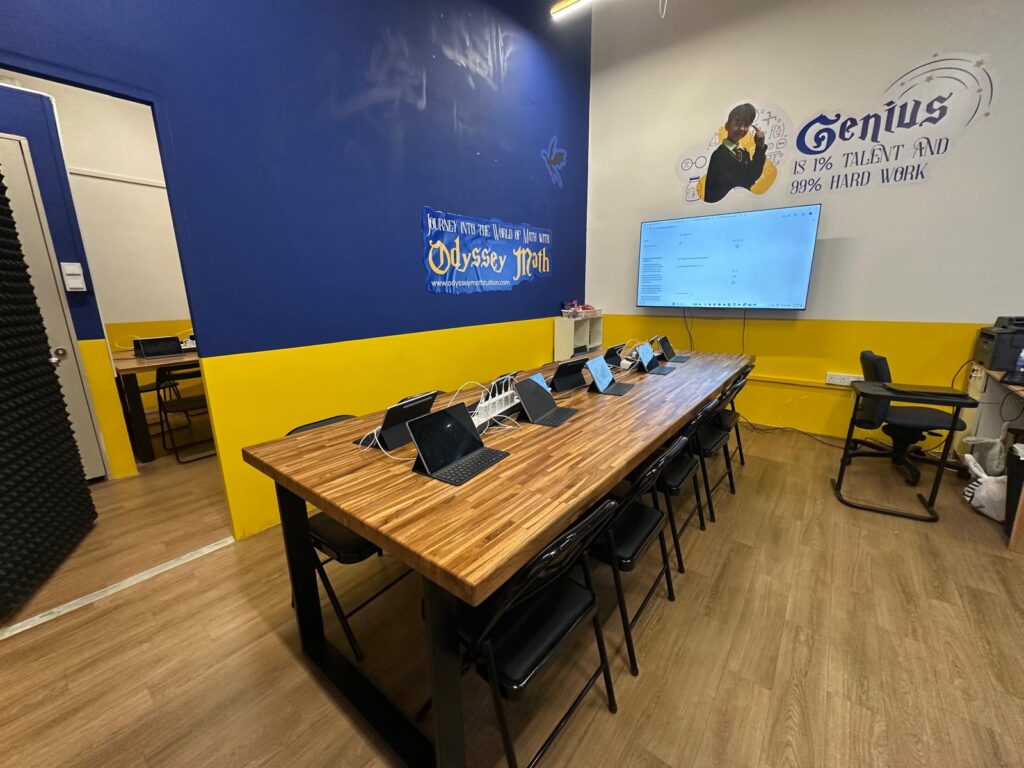
Small groups suit most primary children; one-to-one suits a specific and identifiable gap. The choice should follow the diagnosis rather than the budget.
What a small group gives
Children hear other children being wrong, and being corrected. That is genuinely valuable: it normalises error, and it exposes a child to misconceptions they had not thought of.
It also provides pace. A group moves, and most primary children work better with some momentum than with unlimited time on each question.
What one-to-one gives
Complete attention, which matters when the difficulty is specific and needs unpicking question by question.
It also allows going backwards without embarrassment, which some children need before they will engage at all.
Choosing between them
If the diagnosis is a specific foundational gap, one-to-one for a period can be the faster route, followed by a return to a group.
If the difficulty is general — pace, confidence, exam technique — a small group usually serves better and sustains motivation more.
Class size matters more than the label. A “small group” of fifteen is a class, and the attention available in it is not what most parents are picturing.
Choose by the diagnosis:
- Specific foundational gap — one-to-one for a period may be faster
- Pace or confidence — small group usually better
- Exam technique — group works well, since discussion helps
- Severe avoidance — one-to-one first, then move into a group
Questions worth asking
How many children are actually in the room, and how is the lesson structured so that each gets attention?
How is a child who has quietly stopped following identified during the lesson rather than at the end of term?
What lessons at Odyssey are actually like
What the teaching looks like from a student’s side. This is a secondary student — primary lessons follow the same approach at an age-appropriate pace. More are on Odyssey Math TV.
Where Odyssey fits
Everything here applies across the full maths tuition programme, including primary maths tuition.
We teach in small groups because most primary children benefit from hearing others work, while keeping the class small enough that a quiet struggle is noticed the same day.
We teach maths only, in small classes at Hexacube, 160 Changi Road #01-02, about three minutes from Eunos MRT. See the primary and secondary programmes, our MOE-aligned curriculum, schedules and fees, or the tutors who teach. Free video solutions to past-year papers are on Odyssey Math TV.
It is also why a difficulty in one year is so often a leftover from an earlier one. Because our curriculum spans Primary 1 through Primary 6, we can go back to the genuine cause rather than treating the symptom in front of us. A child struggling with Primary 5 fractions frequently has a Primary 3 equivalence problem, and no amount of Primary 5 practice will resolve it.
Start with the free trial lesson. We use it to work out where the difficulty really sits, and we will say so plainly — including if we think the sensible course is to wait a term and watch. Parents generally find that more useful than a confident sales answer. Get in touch or WhatsApp +65 8512 6882.
What we describe here comes from teaching this syllabus in our own classes since 2012. It is not a forecast for any individual child: progress is produced jointly, by a student willing to do the work with support at home. We do not promise grades. Topics follow the MOE primary mathematics syllabus — check the current syllabus on the MOE website for the definitive version, and see our curriculum page for how we teach it.
Related reading
- Notation Errors in H2 Mathematics
- The Risk of Copying AI Maths Solutions
- Spaced Practice: Why Maths Revision Should Be Spread Out
- Supervising AI-Assisted Maths Homework
- Group vs One-to-One Math Tuition: Which Suits Your Child?
-end
Frequently asked questions
Is one-to-one always better?
No. It costs more and removes the benefit of hearing other children reason. It is stronger for a specific identified gap and weaker for general improvement.
What counts as a small group?
Small enough that the tutor sees each child’s working during the lesson. Ask for the actual number rather than the description.
Can we switch between them?
Often the sensible route — one-to-one to close a gap, then a group to maintain pace and motivation.
Does group tuition suit a shy child?
Frequently yes, provided the group is genuinely small. Many quiet children prefer not being the sole focus of attention for an hour.