
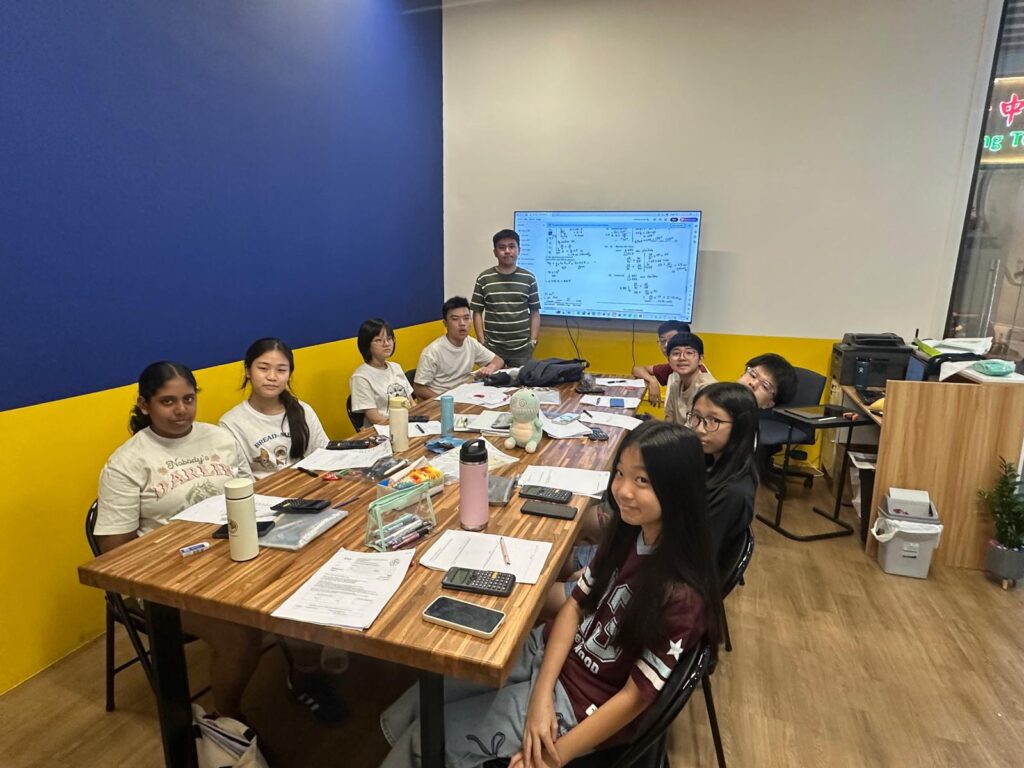
Primary 5 covers building solids with unit cubes, measuring volume in cubic units, drawing cubes and cuboids on isometric grid, the volume of a cube or cuboid, the volume of liquid in a rectangular tank, and the relationship between litres and cubic centimetres.
What volume of cubes and cuboids actually asks of a Primary 5 student
Volume is the third dimension of the same idea: length measures one direction, area two, volume three. The units follow the same pattern, from cm to cm² to cm³.
The relationship between litres and cubic centimetres is the practically useful fact here — one litre is 1000 cm³ — and it links capacity to volume.
Liquid in a tank questions are where the marks concentrate, because the water level defines a height that must be read from the situation rather than given directly.
What the syllabus covers
Under the MOE primary mathematics syllabus, volume of cubes and cuboids at Primary 5 covers:
- building solids with unit cubes
- measuring volume in cubic units, cm³ and m³, excluding conversion between them
- drawing cubes and cuboids on isometric grid
- volume of a cube or cuboid
- finding the volume of liquid in a rectangular tank
- relationship between litres or millilitres and cm³
Where the marks actually go
Using square units for volume. Volume answers are in cubic units and the notation is marked.
In tank questions, using the height of the tank rather than the height of the water.
Confusing capacity and volume, or converting between litres and cm³ in the wrong direction.
How to practise this properly
Build a cuboid from unit cubes and count them, then compare with the formula. The formula stops being arbitrary once it has been checked against a count.
In tank questions, mark the water height on the diagram before calculating anything.
Learn one litre equals 1000 cm³ as a fact and use it in both directions.
Check units at the end of every question, since this is the topic where they are most often wrong.
What this leads to
Primary 6 works backwards from volume to find a missing dimension, and secondary work extends to prisms and cylinders using the same base-times-height idea.
Because each year assumes the last, we teach the primary levels as one continuous sequence. Our MOE-aligned curriculum covers Primary 1 through Primary 6, so repair happens at the source rather than at the surface. In practice that often means spending a lesson on something from two years ago in order to fix what is failing today.
What lessons at Odyssey are actually like
A student describes the experience in her own words. She is in secondary school, and the teaching she describes is what we do at primary level too. More are on Odyssey Math TV.
Getting help with this topic
This topic is taught in the Primary 5 programme at our Eunos centre, part of maths tuition at Odyssey covering Primary 1 through JC2.
We teach Primary 5 maths in small classes at Hexacube, 160 Changi Road #01-02, about three minutes from Eunos MRT. You can see our class schedules and fees, read about our math tutors, or look through the primary school math tuition programme as a whole. If your child is in a nearby school, our primary school directory may be useful too.
A free trial class costs you an hour and tells you where the real gap is. For most families that is more useful than another assessment book, because the problem is rarely a shortage of practice and usually a specific misunderstanding nobody has found yet. Book one here or WhatsApp +65 8512 6882.
What we describe here comes from teaching this syllabus in our own classes since 2012. It is not a forecast for any individual child: progress is produced jointly, by a student willing to do the work with support at home. We do not promise grades. Topics follow the MOE primary mathematics syllabus — check the current syllabus on the MOE website for the definitive version, and see our curriculum page for how we teach it.
Related reading
- Working Backwards from Volume: A Primary 6 Guide
- Order of Operations: A Primary 5 Guide
- Rate: A Primary 5 Guide
- Multiplying Fractions: A Primary 5 Guide
- Primary 5 Maths: Where Students Actually Lose Marks
-end
Frequently asked questions
What units are used for volume?
Cubic units — cm³ and m³. Conversion between those two is excluded at this level.
How do litres relate to cubic centimetres?
One litre is 1000 cm³, and one millilitre is 1 cm³.
What is the commonest error in tank questions?
Using the tank’s height instead of the water’s height. Marking the water level on the diagram first prevents it.
Is drawing on isometric grid examined?
Drawing cubes and cuboids on isometric grid is specified in the syllabus at this level.