
Primary 6 covers ratio notation a:b and a:b:c with whole numbers, equivalent ratios, dividing a quantity in a given ratio, simplest form, finding the ratio of two or three quantities, missing terms, and the relationship between fraction and ratio.
What ratio actually asks of a Primary 6 student
Ratio compares parts with each other; a fraction compares a part with the whole. Confusing the two is the defining difficulty of this topic.
If sweets are shared 2:3, one child gets two fifths and the other three fifths — five parts in total. Children who write two thirds have compared a part with the other part rather than with the whole.
Dividing a quantity in a given ratio is the most examined skill, and it follows directly from counting the total number of parts.
What the syllabus covers
Under the MOE primary mathematics syllabus, ratio at Primary 6 covers:
- notation, representations and interpretation of a:b and a:b:c with whole numbers
- equivalent ratios
- dividing a quantity in a given ratio
- expressing a ratio in its simplest form
- finding the ratio of two or three given quantities
- finding the missing term in a pair of equivalent ratios
- relationship between fraction and ratio
Where the marks actually go
Treating a ratio as a fraction directly, so 2:3 becomes two thirds instead of two fifths.
Forgetting to total the parts before dividing a quantity.
Simplifying only part of a three-term ratio, or simplifying when the question wanted the original form.
How to practise this properly
Always write the total number of parts first. For 2:3, write 5. Everything follows from that number and most errors disappear.
Find the value of one part, then multiply. Two clear steps rather than one leap.
Practise converting between ratio and fraction in both directions until the distinction is automatic.
Check that the parts add back to the original total — a quick verification that catches most slips.
What this leads to
Ratio underpins secondary proportion, scale drawing, similar figures and trigonometry. It is one of the highest-leverage topics in the primary syllabus.
Topics in primary mathematics are cumulative, which is the argument for treating the six years as a single programme rather than a series of annual courses. Our MOE-aligned curriculum does exactly that, from Primary 1 to Primary 6, so nothing has to be guessed about what a child was or was not taught before they arrived.
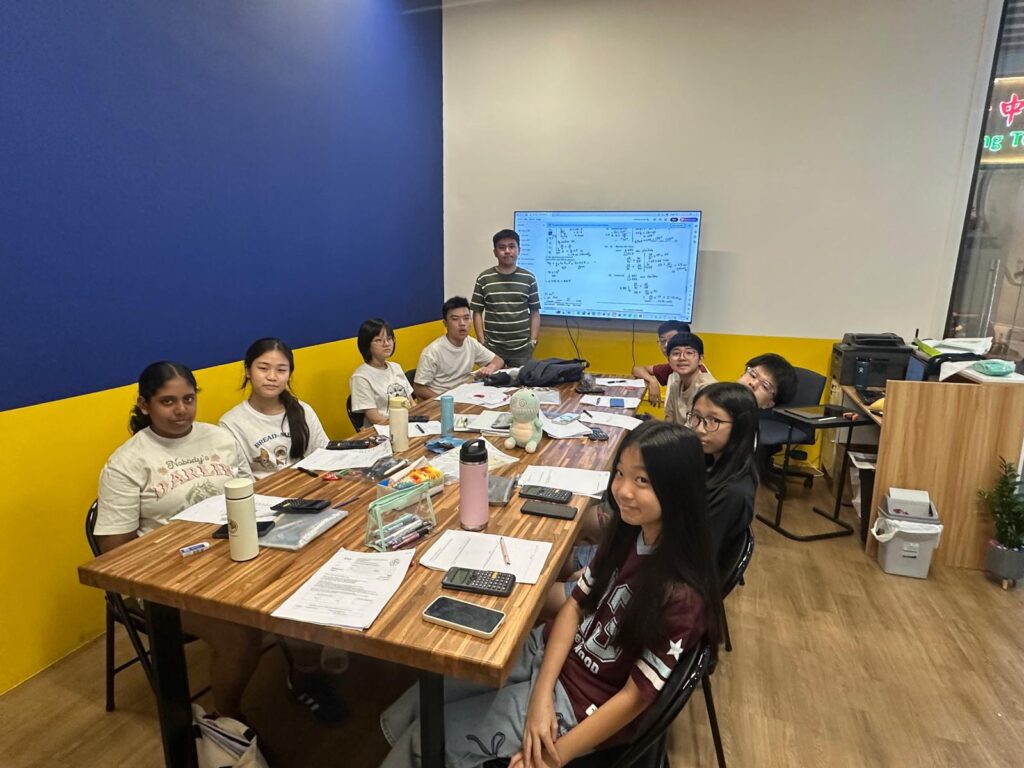
What lessons at Odyssey are actually like
One of our students, unscripted, on how the lessons run. Secondary level in this clip; the same method underlies the primary classes. More are on Odyssey Math TV.
Getting help with this topic
This topic is taught in Primary 6 maths tuition in Singapore at our Eunos centre, part of the full maths tuition programme covering Primary 1 through JC2.
We teach Primary 6 maths in small classes at Hexacube, 160 Changi Road #01-02, about three minutes from Eunos MRT. You can see our class schedules and fees, read about our math tutors, or look through the primary school math tuition programme as a whole. If your child is in a nearby school, our primary school directory may be useful too.
If this topic is the one causing trouble at home, a free trial class is the quickest way to find out why. An hour with a tutor who has taught the whole primary syllabus usually locates the cause faster than weeks of extra worksheets. No obligation either way — book a trial or WhatsApp +65 8512 6882.
What we describe here comes from teaching this syllabus in our own classes since 2012. It is not a forecast for any individual child: progress is produced jointly, by a student willing to do the work with support at home. We do not promise grades. Topics follow the MOE primary mathematics syllabus — check the current syllabus on the MOE website for the definitive version, and see our curriculum page for how we teach it.
Related reading
- Unknown Angles in Composite Figures: A Primary 6 Geometry Guide
- Algebra at Primary 6: Letters, Expressions and Simple Equations
- Percentage Increase, Decrease and Finding the Whole: A Primary 6 Guide
- Working Backwards from Volume: A Primary 6 Guide
- Primary 6 Math: The Final-Year Plan
-end
Frequently asked questions
What is the difference between ratio and fraction?
A ratio compares parts with each other; a fraction compares a part with the whole. In 2:3, the first share is two fifths of the total.
How do you divide a quantity in a given ratio?
Add the parts to get the total number of shares, divide the quantity by that, then multiply by each part.
What is simplest form for a ratio?
Where the terms share no common factor. 4:6 simplifies to 2:3.
Are ratios with fractions included?
No. The syllabus specifies whole numbers, excluding ratios involving fractions and decimals.