
Primary 5 covers rate as the amount of a quantity per unit of another quantity, and finding the rate, the total amount or the number of units when the other two are given.
What rate actually asks of a Primary 5 student
A rate compares two different quantities: dollars per kilogram, words per minute, litres per hour. The word “per” is doing the work, and it always means “for each one”.
Three quantities are involved, and any two determine the third. Recognising which two you have is most of the difficulty.
Note that speed is not part of this syllabus. Rate is the general idea, applied to whatever pair of quantities a question describes.
What the syllabus covers
Under the MOE primary mathematics syllabus, rate at Primary 5 covers:
- rate as the amount of a quantity per unit of another quantity
- finding rate, total amount or number of units given the other two quantities
Where the marks actually go
Multiplying where dividing was needed, usually because the child did not identify which quantity was the rate.
Units dropped, so an answer of “12” does not say whether that is dollars, dollars per kilo, or kilos.
Rates given per unit not converted when the question asks about a different number of units.
How to practise this properly
Write the rate with its units every time — $3 per kg, not just 3. The units tell you what operation is needed.
Ask what “one” costs or produces first. Once the per-unit value is known, everything else is multiplication.
Sanity-check the direction: more units should mean a larger total.
Use shopping and cooking examples, where rates are natural and errors are obvious.
Give questions where the rate itself is what is missing, not just the total. Children get plenty of practice multiplying a known rate and far less at recovering a rate from a total and a count, which is the form that appears in the harder word problems.
What this leads to
Secondary work on proportion, and eventually speed and density, all use this same structure of three related quantities.
A weakness at this stage rarely announces itself. It surfaces a year or two later wearing a different name, which is why parents so often report that the trouble “started” in a year where it merely became visible. Teaching Primary 1 through Primary 6 on one curriculum is what makes tracing it back to the real starting point practical rather than speculative.
What lessons at Odyssey are actually like
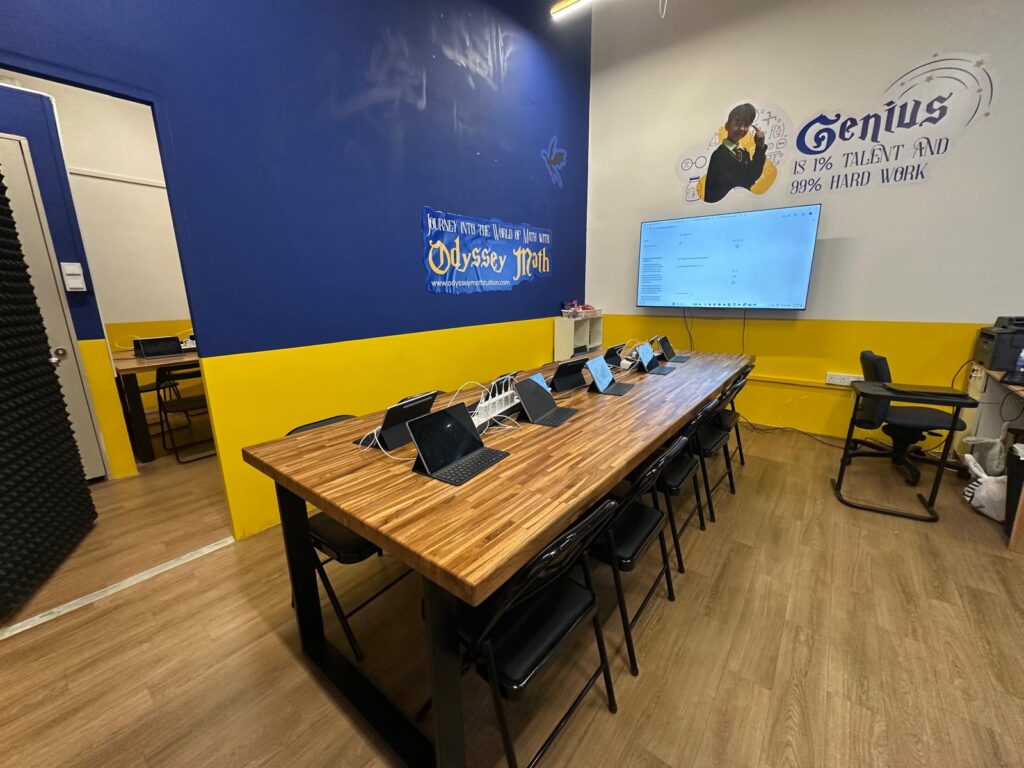
What the teaching looks like from a student’s side. This is a secondary student — primary lessons follow the same approach at an age-appropriate pace. More are on Odyssey Math TV.
Getting help with this topic
This topic is taught in the Primary 5 programme at our Eunos centre, part of maths tuition at Odyssey covering Primary 1 through JC2.
We teach Primary 5 maths in small classes at Hexacube, 160 Changi Road #01-02, about three minutes from Eunos MRT. You can see our class schedules and fees, read about our math tutors, or look through the primary school math tuition programme as a whole. If your child is in a nearby school, our primary school directory may be useful too.
Come and sit in on a lesson before deciding anything. The first one is free and its purpose is diagnostic: we want to know what your child can actually do, not what a report card says. Arrange a free trial or WhatsApp +65 8512 6882.
What we describe here comes from teaching this syllabus in our own classes since 2012. It is not a forecast for any individual child: progress is produced jointly, by a student willing to do the work with support at home. We do not promise grades. Topics follow the MOE primary mathematics syllabus — check the current syllabus on the MOE website for the definitive version, and see our curriculum page for how we teach it.
Related reading
- Triangles and Special Quadrilaterals: A Primary 5 Geometry Guide
- Volume of Cubes and Cuboids: A Primary 5 Guide
- Angles on a Line, at a Point and Vertically Opposite: A Primary 5 Guide
- Fractions as Division: A Primary 5 Guide
- Primary 5 Maths: Where Students Actually Lose Marks
-end
Frequently asked questions
What is a rate?
The amount of one quantity for each unit of another — dollars per kilogram, for example.
Is speed part of the Primary 5 syllabus?
Speed is not a topic in the 2021 primary mathematics syllabus. Rate is the general concept taught at Primary 5.
How do you find the total from a rate?
Multiply the rate by the number of units. Finding the rate instead requires dividing the total by the units.
Why do units matter so much here?
Because they tell you which quantity is which. Writing them down usually reveals the correct operation without further thought.