Primary 4 covers identifying and drawing 2D representations of solids, identifying the nets of cubes, cuboids, prisms and pyramids, and identifying which solid a given net forms.
What nets actually asks of a Primary 4 student
This topic asks a child to move between two and three dimensions in their head, which is genuinely difficult and varies enormously between children.
Given a net, name the solid. Given a solid, decide which of several nets would fold to make it. The second is much harder, because plausible-looking nets often overlap when folded.
Spatial visualisation improves with handling real objects far more than with looking at diagrams, which is worth knowing before buying another worksheet book.
What the syllabus covers
Under the MOE primary mathematics syllabus, nets at Primary 4 covers:
- identifying 2D representations of cube, cuboid, cone, cylinder, prism and pyramid
- drawing 2D representations of cube, cuboid, prism and pyramid
- identifying the nets of cube, cuboid, prism and pyramid
- identifying the solid which can be formed by a given net
Where the marks actually go
Choosing a net that overlaps when folded, because it has the right number of faces and looks reasonable.
Confusing prisms and pyramids. A prism has two identical ends joined by rectangles; a pyramid rises to a point.
Counting faces correctly but not checking their arrangement, which is what actually decides whether a net works.
How to practise this properly
Cut out and fold nets. Nothing on paper substitutes for the moment a net either closes into a solid or does not.
Count faces first as a quick filter, then check the arrangement. A cube net must have six squares, but not every six-square arrangement folds into a cube.
Unfold a real box and look at the net it makes. Working backwards from a solid is often easier than forwards.
Learn the distinguishing feature of prisms and pyramids as a sentence, so the names are attached to a property rather than to a picture.
What this leads to
Volume of cubes and cuboids follows at Primary 5, and surface area at secondary level uses nets directly. The visualisation practised here is the transferable part.
A weakness at this stage rarely announces itself. It surfaces a year or two later wearing a different name, which is why parents so often report that the trouble “started” in a year where it merely became visible. Teaching Primary 1 through Primary 6 on one curriculum is what makes tracing it back to the real starting point practical rather than speculative.
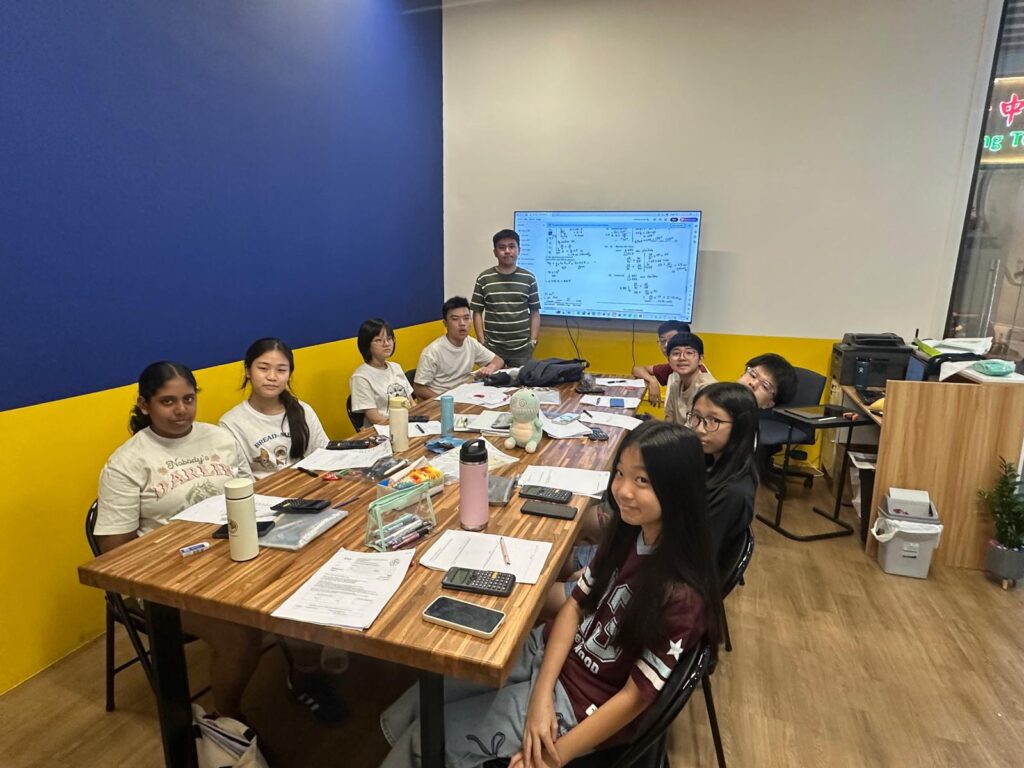
What lessons at Odyssey are actually like
Here is a student talking about what studying with us is actually like. She is at secondary level; the teaching method is the one we use throughout, adjusted to the age. More are on Odyssey Math TV.
Getting help with this topic
This topic is taught in Primary 4 maths tuition in Singapore at our Eunos centre, part of the full maths tuition programme covering Primary 1 through JC2.
We teach Primary 4 maths in small classes at Hexacube, 160 Changi Road #01-02, about three minutes from Eunos MRT. You can see our class schedules and fees, read about our math tutors, or look through the primary school math tuition programme as a whole. If your child is in a nearby school, our primary school directory may be useful too.
Come and sit in on a lesson before deciding anything. The first one is free and its purpose is diagnostic: we want to know what your child can actually do, not what a report card says. Arrange a free trial or WhatsApp +65 8512 6882.
What we describe here comes from teaching this syllabus in our own classes since 2012. It is not a forecast for any individual child: progress is produced jointly, by a student willing to do the work with support at home. We do not promise grades. Topics follow the MOE primary mathematics syllabus — check the current syllabus on the MOE website for the definitive version, and see our curriculum page for how we teach it.
Related reading
- Tables, Line Graphs and Pie Charts: A Primary 4 Guide
- Long Multiplication and Division: A Primary 4 Guide
- Numbers Up to 100 000 and Rounding: A Primary 4 Guide
- Mixed Numbers and Improper Fractions: A Primary 4 Guide
- Primary 4 Math: The Bridge Year
-end
Frequently asked questions
What is a net?
A flat arrangement of shapes that folds up to make a solid.
How can my child tell whether a net works?
Count the faces first, then check whether they are arranged so that nothing overlaps when folded. Cutting and folding one or two makes the pattern clear.
Which solids are covered?
Cubes, cuboids, prisms and pyramids for nets; cones and cylinders are included in identifying 2D representations.
My child finds this much harder than other topics. Is that normal?
Yes. Spatial visualisation varies more between children than arithmetic does, and it responds to handling physical models rather than to more written practice.