
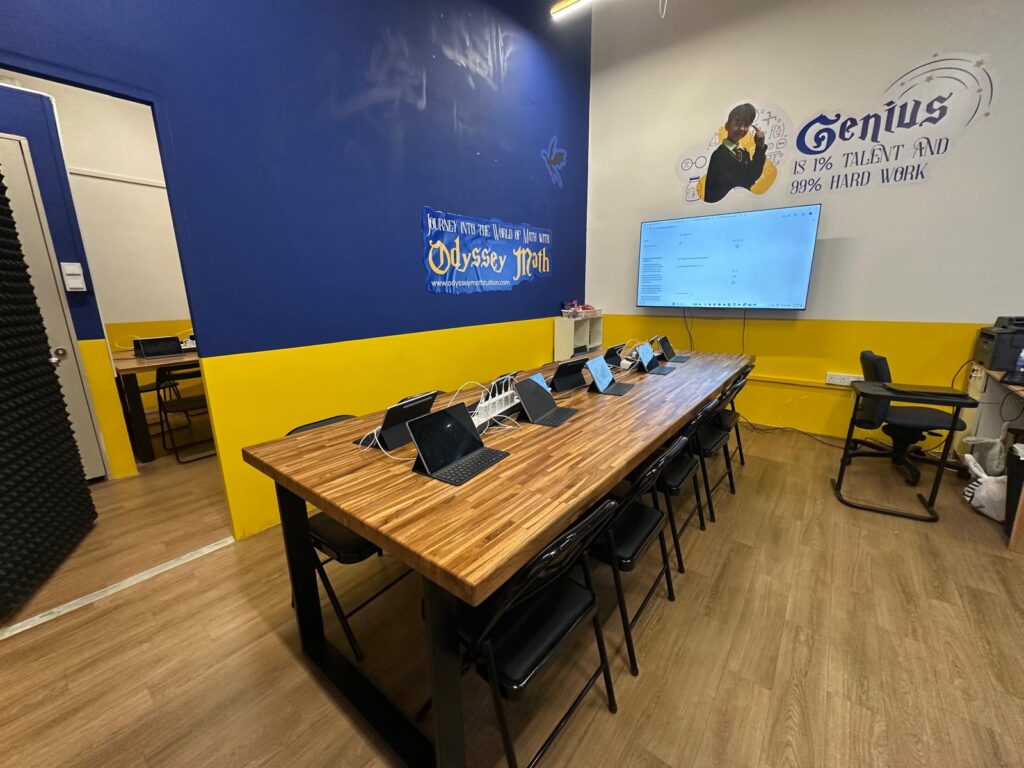
Mid-year mathematics examinations cover a smaller range than end-of-year papers, which makes them the least costly diagnostic a student gets all year. Odyssey Math Tuition’s online courses allow targeted revision of individual topics rather than whole-syllabus coverage.
What mid-years are actually useful for
Mid-year examinations are usually treated as a smaller version of the finals. They are more useful than that: they are an early, low-cost signal about which topics have not landed, at a point in the year when there is still time to act.
A student who treats the mid-year result as information rather than as a verdict gains several months of advantage over one who treats it as a disappointment and moves on.
Phase one: find out what is actually weak
Revision fails most often because it is spread evenly over material that is not evenly secure. The first week should produce a list, not coverage.
- Take a topical test cold on each major topic, with no revision beforehand.
- Record the mark and, more usefully, the type of error.
- Sort every topic into secure, shaky or absent.
- Set the secure pile aside completely for the next month.
Most students find four or five genuinely weak topics rather than twenty, which is what makes the rest of the plan possible.
Phase two: repair, one topic at a time
Because the covered range is narrower, repair can be more thorough. Work each weak topic to the point where the topical test is passed comfortably rather than barely.
Use the narrower scope to fix foundations rather than to cram. A gap in algebraic manipulation found in May is inexpensive; the same gap found in October is not.
Where the syllabus for the mid-year includes material from the previous year, revise that material at its own level rather than in summary.
Phase three: whole papers under real conditions
Full-paper practice only pays once the weak topics are repaired. Before that it mostly measures the same gaps over and over.
- Sit the paper at the real time limit, in one sitting, without notes
- Mark it honestly, awarding method marks as an examiner would
- Categorise every lost mark as knowledge, method or execution
- Repair knowledge losses; drill execution losses under time
The past-year school examination papers included in the courses are useful here precisely because they show how topics are examined rather than how they are taught.
The two error types that need opposite treatment
Marks lost because a method was unavailable and marks lost because a known method was executed badly look identical on the script and need entirely different responses.
- Knowledge losses — return to the topic explanation and practice.
- Execution losses — sign errors, misread questions, premature rounding, missing units. Drill under time; re-learning the topic will not help.
Most students in the final months have far more execution losses than knowledge losses and revise as though the reverse were true. That single misallocation costs more marks than any individual topic.
The last fortnight
In the week before the paper, switch from learning to rehearsal: timed questions, reviewing previous errors, and checking presentation habits.
Do not attempt to cover topics that have not been taught yet. Mid-year papers examine what has been covered, and time spent ahead of the class is time not spent repairing.
After the paper, spend an hour categorising every lost mark. That hour is worth more than the revision that preceded it.
Where the online course fits
The Secondary 3 course provides the pieces this plan assumes: recorded explanations for repair, topical practice for fluency, topical tests for honest diagnosis, and past-year school examination papers with worked answers. Access is 24 hours a day with unlimited replays, which matters in a revision period when study happens at irregular hours.
Every online course carries a 7-day money-back guarantee, and the terms are published in full. For the wider picture of this stage, see our guide to the year and the subject guide.
Syllabus details follow Ministry of Education and SEAB published documents. Course details and prices are as published at the time of writing — check the course pages for current information. We do not promise grades.
Read next
Related reading on studying maths online: Self-Paced Math Learning: Who It Suits, and Who It Does Not, Unlimited Replays: The Most Underrated Part of an Online Math Course, What 24/7 Access to a Math Course Actually Changes, Equations and Inequalities: A Sec 3 E-Math Guide, Differential Equations in H2 Mathematics: A JC2 Guide. On choosing a school, our list of primary schools in Singapore and list of secondary schools in Singapore set out what differs between them.
More on getting the most from your maths
Frequently asked questions
Should revision be by topic or by whole paper?
By topic first, to repair gaps, then by whole paper under time. Doing whole papers first mostly measures the same gaps repeatedly.
Are past-year papers included in the online course?
Yes. The courses include past-year school examination papers with worked answers alongside the topical material.
How many past-year papers are enough?
Fewer, marked honestly and analysed properly, beat many done quickly. Categorising each lost mark is what makes a paper worth doing.
What if the gap comes from an earlier year?
Repair it at the level where it formed. Building on unstable foundations is how revision time gets wasted.
Can we subscribe for a short period before the exam?
Several access lengths are published on the course page, and every online course carries a 7-day money-back guarantee.
Does the course cover the whole syllabus?
Yes. The Secondary 3 E-Math online course covers the level topic by topic, with practice and tests for each.
Last reviewed July 2026. Syllabus details follow the Ministry of Education and SEAB published documents.