
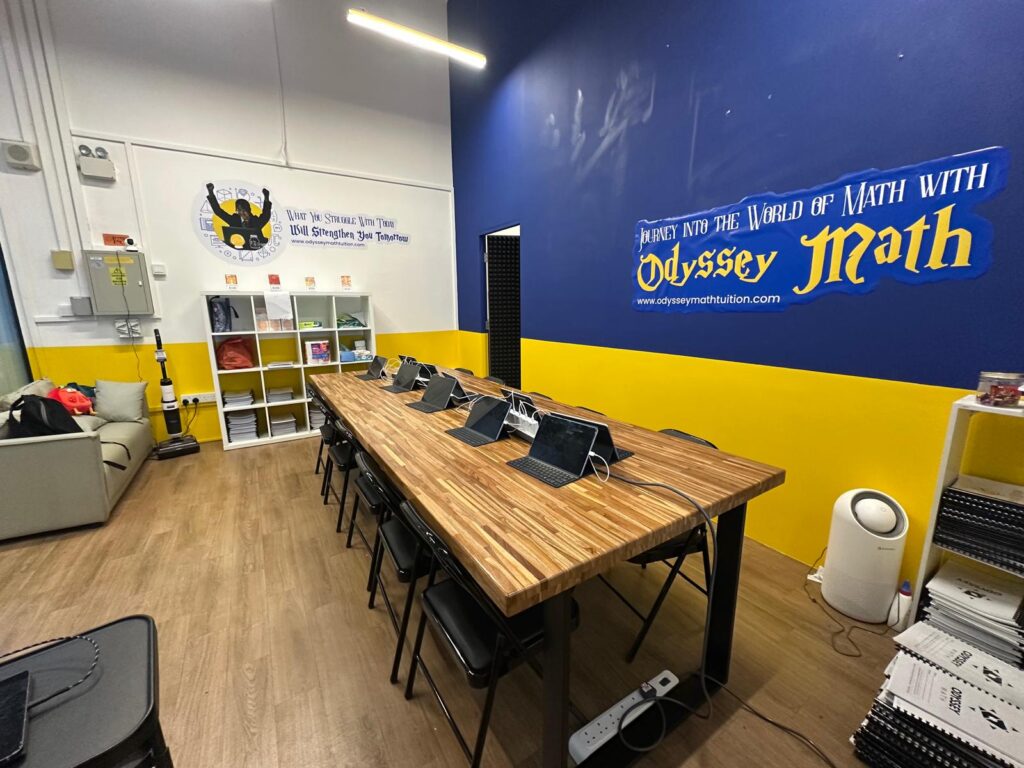
An online math course alone is usually sufficient when a student is broadly coping, can tell when they do not understand something, and will act on it. It is usually not sufficient when a student goes quiet under difficulty, because Odyssey Math Tuition’s recordings cannot notice that and a teacher can.
It would be convenient for us to argue that every student needs a weekly class. That is not true, and families work it out quickly enough anyway.
The profile that does well without a class
The capable student with a specific gap. Broadly fine, lost on one or two topics. They do not need a course re-taught weekly; they need those topics, properly, once.
The self-starting student. They attempt questions before looking at solutions, they notice when an answer was a guess, and they go back. This is a habit more than a talent.
The student with no room in the week. Sport, music, a heavy CCA load. A fixed Saturday slot is the wrong shape; a course that opens at 10pm is not.
The student revising an earlier year. Nobody runs a weekly class in last year’s syllabus. This is one of the clearest cases for online material.
The profile that needs a person
A student who stops when stuck. A student who has decided they are not a maths person — a pattern that often starts earlier than parents realise. A student who reports that everything is fine while the marks say otherwise. None of these are solved by better explanations, because explanations were never the bottleneck.
A test that costs nothing
Give your child a past-year paper at the real time limit and watch where they pause. Then ask what they did about the pause. “Left it” is a different diagnosis from “looked it up”, and it points to a different format.
Our fuller test for whether tuition is needed at all is worth reading before paying for either. If the answer points to support, the nine criteria set out what to look for.
What to watch in the first fortnight
Two weeks is enough to know. The signals worth watching are unglamorous:
- Do they open it without being told? Prompted use tells you nothing about whether the format fits.
- Do they attempt before watching? A student who opens the solution first is revising their reading, not their mathematics.
- Do they go back after getting something wrong? This is the habit that makes self-paced study work, and its absence is the clearest argument for a live class.
- Do the topical tests get taken? Watching is comfortable; being marked is not. Students who avoid the test are usually avoiding the answer.
The levels where this decision changes
The calculation is not the same at every stage. At Secondary 1 and 2 the content is manageable and the risk is mostly habit-formation, so a self-directed student can often manage alone. From Secondary 3 onward the load doubles for anyone taking both mathematics subjects, and the margin for drifting quietly shrinks. At JC1 the pace assumes fluency that many students do not yet have, which is why more families add a live class at that point rather than fewer.
The honest hedge
Because this is genuinely hard to judge from the outside, every online course carries a 7-day money-back guarantee. A week is usually enough to see whether your child opens it unprompted, which is one of the clearest early signals.
What we describe comes from how our own courses are built and what we have seen in our own classes; it is not a forecast for any individual student. Course details and prices are as published at the time of writing — see the course pages. We do not promise grades.
Read next
Related reading on studying maths online: Revising for Mid-Year Maths Exams With an Online Course, Revising for Prelims With an Online Maths Course, Revising for Weighted Assessments in Lower Secondary Maths, Inside the Junior College 1 H2 Mathematics Online Math Course, Pythagoras’ Theorem: A Secondary 2 Revision Guide, Using the School Holidays for Maths Without Ruining Them. On choosing a school at this stage, see our list of secondary schools in Singapore.
More on getting the most from your maths
Frequently asked questions
Can a student pass O-Level maths using only an online course?
Some do. It depends far more on whether the student uses it when stuck than on the material itself. We cannot promise an outcome, and no centre in Singapore may.
How do I know if my child will actually use it?
The 7-day money-back guarantee exists partly for this. Watch whether they open it without being told during the first week.
Is online cheaper than weekly classes?
Published online prices start lower than termly class fees, but they answer different needs. Compare on the course pages and the schedules and fees page.
What if we start online and it is not working?
Move to a class, or add one. The formats are not exclusive and many families use both.
Which levels are available online?
Secondary 1 to Junior College 2, covering E-Math, A-Math and H2 Mathematics.
Does the course include practice, or only videos?
Both. Each topic has a question bank, topical practice and a topical test alongside the video lessons.
Last reviewed July 2026. Syllabus details follow the Ministry of Education and SEAB published documents.