
Useful notes from a video mathematics lesson record the method and the moment of difficulty, not the full working. A student who transcribes everything ends the session with a neat copy of something they did not learn. Pausing to write in your own words is what makes the note worth having later.
The transcription problem
Video lessons invite copying because they can be paused. Students pause, copy the line, resume, copy the next. At the end they have an accurate record and very little understanding, because copying is a motor task rather than a thinking one.
The test is simple: could the student reconstruct the next step without looking? If not, the notes are a transcript.
What is actually worth writing down
- The trigger. What in the question told you to use this method?
- The method skeleton. Three or four lines, not twenty.
- The step you would not have thought of. This is the highest-value line on the page.
- The mistake you made in your own attempt, and why it was wrong.
- One question to try later without help.
A format that survives revision
Notes are written for a version of yourself three weeks from now who has forgotten everything. That reader does not need the full working; they need to know which method applies and what to watch out for.
- Topic and date at the top.
- Trigger: “when the question gives two equations and one is non-linear…”
- Method in short lines.
- Trap: the thing that caught you.
- One unsolved practice question to test yourself with later.
Why pausing matters more than rewinding
Unlimited replays make it tempting to keep the video running and rewind later. Pausing is better. A pause forces a decision about what mattered; a rewind postpones it.
In our online courses the explanation, the practice and the test sit together, so the natural rhythm is watch a segment, pause, write four lines, attempt a question.
An error log is worth more than a summary
The most useful page a student keeps is not a summary of methods. It is a running list of mistakes: what they wrote, what was wrong about it, and what the correct trigger was.
Mathematics mistakes repeat. A student who drops a negative sign in Secondary 2 is usually still dropping it in Secondary 4 unless something interrupted the habit. Writing the error down is that interruption, and re-reading the log before a test is worth more than re-reading the chapter.
- Sign errors and bracket expansion
- Reading the question wrongly — answering what was not asked
- Method chosen correctly but arithmetic lost near the end
- Rounding too early and losing accuracy marks
- Leaving out units or the final statement
These are the same patterns that cost marks in national papers. PSLE Paper 2 shows where they accumulate at primary level, and the O-Level E-Math paper rewards exactly the presentation habits an error log builds. Students taking two mathematics subjects should keep one log each, because the mistakes differ: A-Math errors cluster around method selection, E-Math errors around execution under time.
Notes for topics you will meet again
Some topics recur across years and deserve better notes than others. Algebraic manipulation, quadratics and trigonometry all reappear constantly — Secondary 3 assumes all three are fluent. Notes on these are worth keeping through to the examination year; notes on a one-off topic are not.
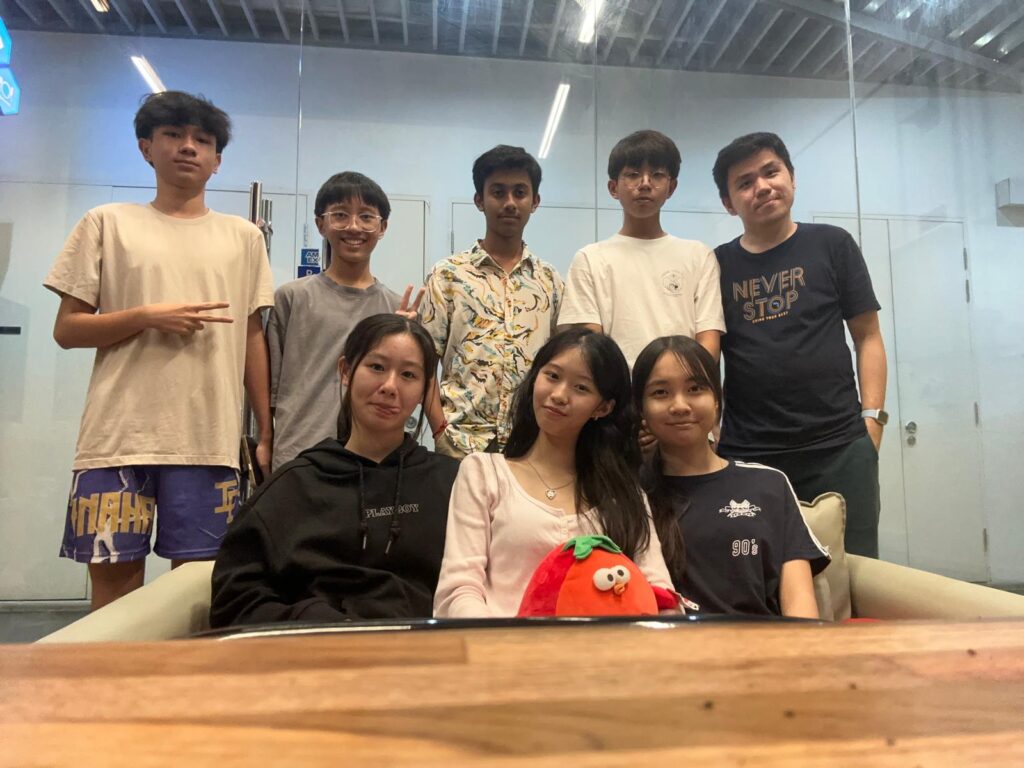
A student on the online course
Myra describes what studying with the online course was actually like.
What we describe comes from how our own courses are built and what we have seen in our own classes; it is not a forecast for any individual student. Course details and prices are as published at the time of writing — see the course pages. We do not promise grades.
Read next
Related reading on studying maths online: Revising for Weighted Assessments in Lower Secondary Maths, Careless Mistakes in Maths Exams and How to Actually Stop Them, Presentation and Method Marks in a Maths Paper, Functions in H2 Mathematics: A JC1 Revision Guide, Number Patterns: A Secondary 1 Revision Guide, Using AI to Check Maths Work Responsibly. On choosing a school, our list of primary schools in Singapore and list of secondary schools in Singapore set out what differs between them.
More on getting the most from your maths
Frequently asked questions
Should my child write notes for every video lesson?
No. Notes are worth taking where the method is new or where they were stuck. Familiar material does not need a record.
Is it better to type or handwrite maths notes?
Handwriting, for mathematics. Notation is faster by hand and the act of writing it out is part of the learning.
How long should notes for one topic be?
Usually less than a page. If it runs longer, it is probably a transcript.
What if my child prefers to just watch?
Watching without writing is comfortable and rarely transfers. Even four lines per topic changes the outcome.
Do the courses provide notes?
Each topic has recorded lessons, a question bank, topical practice and a topical test. Students own their own notes, which is part of the point.
Can lessons be paused and replayed freely?
Yes, without limit, which is what makes pause-and-write practical.
Last reviewed July 2026. Syllabus details follow the Ministry of Education and SEAB published documents.