
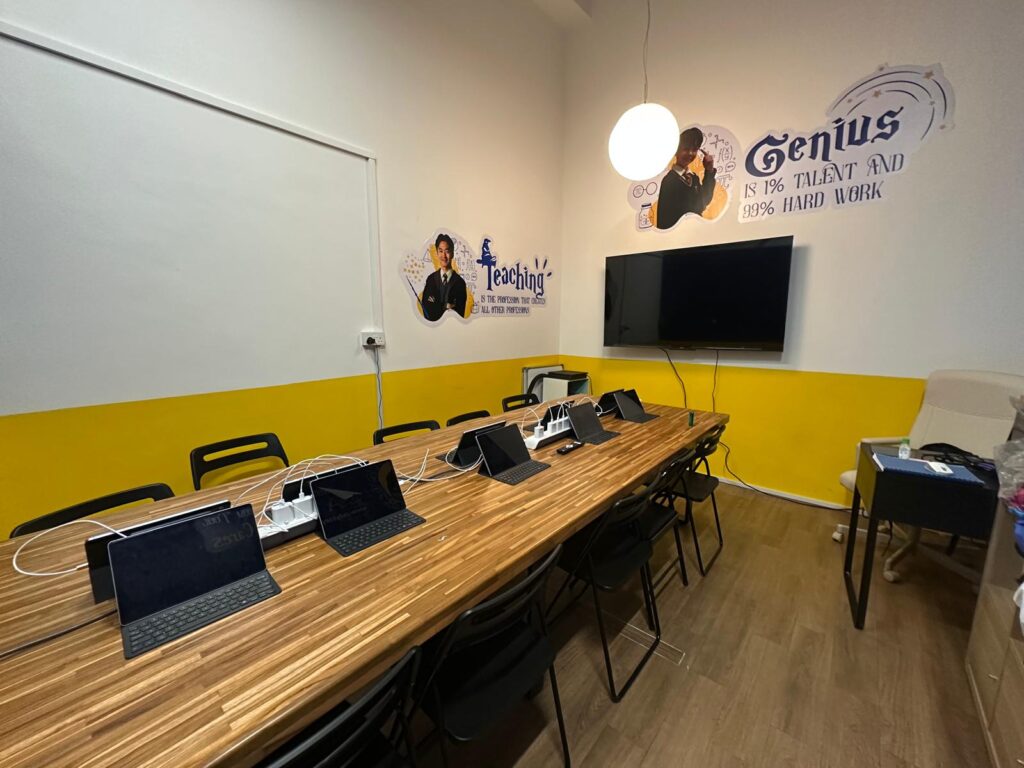
Watching a mathematics solution creates a strong feeling of understanding that disappears the moment a student faces a blank page. The fix is order: attempt the question first, then watch, then re-attempt unaided. Odyssey Math Tuition’s online courses pair every explanation with topical practice and a topical test for exactly this reason.
Why watching feels like learning
When someone explains a solution well, each step looks obvious. That sense of obviousness is real, but it belongs to the explanation, not to the student. Following a path someone else is walking is a different skill from finding it.
This is the single most common way study time gets wasted in a self-paced course. A student spends ninety minutes watching, feels productive, and cannot start the first question the next morning.
The order that works
- Attempt first. Even badly. Even for four minutes. The point is to find out where the wall is.
- Watch the explanation with the specific question in mind.
- Close the video and redo the same question from a blank page.
- Do a different question of the same type. This is where it is proved.
Step three is the one students skip and the one that matters. Redoing a question you have just watched feels pointless and is not: it is the difference between recognising a solution and producing one.
Signs a student is watching rather than working
- The video is open but no paper is out
- They can explain what the teacher did but cannot start a fresh question
- Topical tests get postponed indefinitely
- Everything “makes sense” but marks do not move
Why the course is built in three parts
Every topic in our online courses has an explanation, then topical practice, then a topical test. That structure exists because explanation alone does not transfer. The practice builds fluency; the test tells the truth.
Question-bank answers are recorded and worked through rather than printed as final answers, so a student can see the reasoning — but the same rule applies: attempt before watching.
The two-minute check that exposes it
At the end of a study session, close everything and write down the method for the topic just covered — from memory, in four lines. Not the answer to a specific question; the method.
Students who have been working can do this. Students who have been watching cannot start. It takes two minutes and it is the simplest diagnostic available, which is why it is worth building into the end of a session rather than discovering the problem in a test.
The same check works for parents who want to know whether the hour was real without hovering over it. Ask what the method was, not whether the work is done. The topical tests inside each course do the same job more formally, and they are the part students avoid precisely because they are honest.
Where this matters most
Topics built on pattern recognition suffer worst from passive watching, because patterns form through repeated attempts rather than repeated viewings. Trigonometric identities are the classic case, and A-Math is full of them. Calculus is the other: H2 Mathematics moves quickly and assumes the previous technique is automatic.
What we describe here comes from how our own online courses are built and from what we have seen in our own classes. It is not a forecast for any individual student: progress is produced jointly, by a student willing to put in the work with support at home. We do not promise grades. Course details and prices are as published at the time of writing — check the course pages for current information.
Read next
Related reading on studying maths online: Careless Mistakes in Maths Exams and How to Actually Stop Them, Presentation and Method Marks in a Maths Paper, Maths Crash Courses: What They Are and When to Use One, Congruence and Similarity: A Secondary 2 Revision Guide, Expansion and Factorisation Using Special Identities: A Sec 2 Guide, Using AI to Check Maths Work Responsibly. On choosing a school at this stage, see our list of secondary schools in Singapore.
More on getting the most from your maths
Frequently asked questions
Is it wrong to watch a worked solution?
Not at all — but the order matters. Watching after an honest attempt teaches a great deal; watching instead of attempting teaches very little.
How long should a student attempt before giving up and watching?
For most topics, four to six minutes of genuine effort. Long enough to find the wall, short enough not to entrench a wrong method.
My child says they understand everything but marks are low. Why?
This is the classic signature of passive watching. Understanding an explanation and producing a solution unaided are different skills, and only the second is examined.
Do the courses include practice, or just videos?
Both. Every topic has a question bank, topical practice and a topical test alongside the video lessons.
Should notes be taken while watching?
Yes, but sparingly — the method and the point where you were stuck, not a transcript. Copying everything is another form of passive work.
Can the same topic be rewatched later?
Yes, replays are unlimited, which makes the attempt-first approach cheap to follow.
Last reviewed July 2026. Syllabus details follow the Ministry of Education and SEAB published documents.