
Most Primary 1 children do not need mathematics tuition. What they need is number confidence, comfort with being wrong, and an adult who talks about numbers with them. Formal tuition this early can do more harm than good. Early differences at this age correlate strongly with birth month and narrow substantially by upper primary.
This is not the article a tuition centre is expected to write, but it is the honest one. Primary 1 is rarely the right moment for formal mathematics tuition, and we turn away more enquiries at this level than at any other.
We write it because the alternative is taking money for something that will not help, and because the families who enrol a six-year-old on our advice would be the ones least well served by it. There is a version of this business that says yes to everything, and it is not one we are interested in running.
None of which means Primary 1 mathematics does not matter. It matters enormously — just not in the way an extra weekly class addresses.
The content is modest; the real work is attitudinal
Numbers to 100, addition and subtraction within 100, simple multiplication and division concepts, basic shapes, length and time. The content is modest. The real work is attitudinal — a child is learning what mathematics is and whether they are the sort of person who can do it.
The content is genuinely modest, and that is the point. What a six-year-old is really learning in Primary 1 is what mathematics is, and whether they are the kind of person who can do it. Those conclusions form early, they form from experience rather than instruction, and they are remarkably durable.
A child who leaves Primary 1 believing that being stuck is normal and temporary has been given something worth more than a year of head start on content.
Three reasons early tuition often backfires
Three reasons, in our experience:
- It can teach dependence. A six-year-old who learns that an adult will provide the method may not develop the habit of trying first.
- It can front-load pressure. Mathematics anxiety established at six is remarkably durable, and it is the single most common reason older students underperform relative to ability.
- It solves a problem that usually is not there. Most Primary 1 differences reflect developmental timing, not ability, and they narrow on their own.
What genuinely helps at six
- Talking about numbers in ordinary life — quantities, comparisons, sharing, time. Constant, low-stakes exposure.
- Letting them be wrong comfortably. A child who is afraid of wrong answers stops attempting hard ones, which is the actual long-term risk.
- Reading. Word problems are reading problems. Reading fluency at six predicts mathematics performance at eleven more than early arithmetic drilling does.
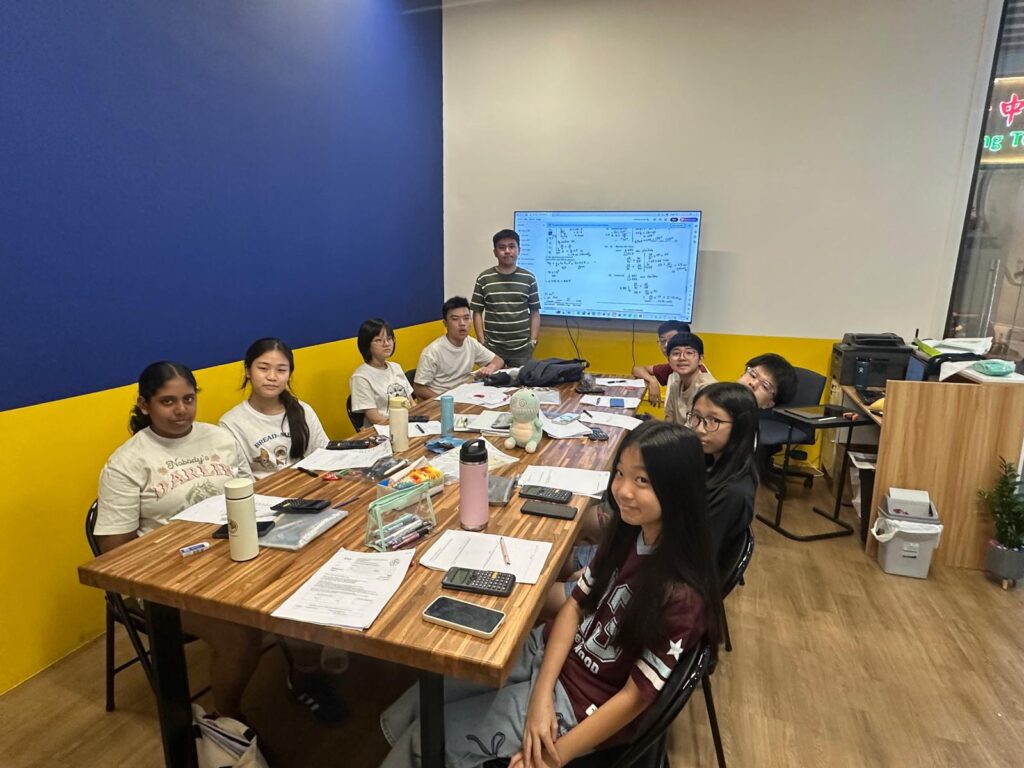
Sit in on a lesson first. We run a free trial class at our centre at Hexacube, 160 Changi Road — about three minutes from Eunos MRT. Message us on WhatsApp to book, or see class schedules and fees. See what we cover in this level.
The specific cases where we would say yes
Rarely, but genuinely sometimes. Where a child has a specific, identified learning difficulty and needs specialist support. Where a child has arrived in Primary 1 without the foundational counting concepts their classmates have and is visibly distressed. Where a family has moved into the Singapore system mid-stream and there is real content to bridge.
Those are specific situations, not general ones. If you are unsure, our FAQ covers how we assess it, and we will tell you if we think you should wait. Our primary school math tuition pages set out the levels where we think support genuinely earns its place.
Children who are ahead need harder problems, not later topics
This comes up often, and the answer surprises people. A Primary 1 child who is visibly ahead of the class usually benefits least from formal tuition, because tuition tends to accelerate through content rather than deepen it.
What extends a capable six-year-old is harder problems, not later topics. A child who can add fluently gains more from a genuinely puzzling question about numbers to 100 than from being moved on to numbers to 1,000. The first builds reasoning; the second builds coverage.
Acceleration also has a cost that shows up years later. Children who arrive in Primary 5 having already seen the content once frequently disengage, having concluded that mathematics is something you have already done rather than something you think about.
Read next
If you want to see how the primary years connect, Primary 2 and the number sense everything rests on comes next, followed by Primary 3, where word problems turn multi-step and Primary 4, the bridge year. If you are weighing up support at any level, our home test for whether a child actually needs math tuition is the place to start. If you are still choosing a school, our list of primary schools in Singapore sets out each school’s programmes and strengths. On studying this online, see What AI Can and Cannot Do for Maths Learning, Why Worked Solutions Still Matter More Than Final Answers and Revising for Mid-Year Maths Exams With an Online Course.
Topic guides for this level
Each topic below has its own guide covering what it asks, where marks are lost and how to practise it:
- Addition and Subtraction Within 100: A Primary 1 Guide
- Length at Primary 1: Measuring in Centimetres
- Money at Primary 1: Counting Cents and Dollars
- Multiplication and Division at Primary 1: What It Really Covers
- Numbers Up to 100: A Primary 1 Guide for Parents
- Picture Graphs at Primary 1: Reading Data for the First Time
- Telling Time at Primary 1: Hours, Minutes, am and pm
-end
Related guides
Frequently asked questions
Will my child fall behind if we do not start tuition early?
For the overwhelming majority of Primary 1 children, no. Early differences in mathematics attainment correlate strongly with birth month and developmental timing, and they narrow substantially by upper primary. Starting early is not the advantage it is often presented as.
My child says they hate maths in Primary 1. What should I do?
Take it seriously, but not as a mathematics problem. At this age it is nearly always about the experience of being wrong in front of others. Low-stakes number play at home, with no correction and no timing, does more than any formal programme.
What is the earliest level you would recommend tuition?
For most children, Primary 4 or Primary 5, when the content genuinely steepens and gaps start to compound. Before that, the return on formal tuition is usually low and the risk to attitude is real.
What should I do if my child is already ahead?
Give them harder problems rather than later topics. A child who can add fluently gains more from a genuinely puzzling question about numbers to 100 than from being moved on to numbers to 1,000. The first builds reasoning; the second only builds coverage.
At what level do you actually recommend starting tuition?
For most children, Primary 4 or Primary 5, when the content steepens and gaps begin to compound. Before that the return on formal tuition is usually low and the risk to a child’s attitude towards mathematics is real. We turn away most Primary 1 and 2 enquiries for that reason.
My child counts on their fingers. Should I stop them?
Not at Primary 1. Finger counting is a normal intermediate stage and usually fades as recall builds. It becomes worth attention only if it is still the primary strategy by the end of Primary 3, at which point it suggests recall has not developed.
A note on what we can and cannot promise: the patterns described here come from what we have seen in our own classes over the years. They are not a forecast for any individual student. Progress in mathematics is produced jointly — our teachers work hard for a student who is willing to put in the effort, with support at home. We do not promise grades.
Last reviewed July 2026. Syllabus details follow the Ministry of Education and SEAB published documents.