
Frequency matters more than volume at primary level. Short, regular, targeted practice outperforms long sessions, and practice on secure topics adds little.
Volume is the wrong measure
Parents commonly ask how many questions a day. The more useful question is which questions, because practice on topics a child already knows produces almost no improvement.
A child doing forty questions on material they have mastered has worked hard and learned little. Ten questions on the weak topic would have been worth more.
What frequency does
Spaced practice beats massed practice for retention, and the effect is large. Fifteen minutes on five days does more than seventy-five minutes on one.
This matters most for facts that must become automatic — tables, number bonds, conversions — where recall improves with repeated brief exposure.
Diminishing returns and their cost
Beyond a certain point extra practice mostly produces fatigue and resentment, and a child who resents the subject will avoid it, which costs more than the extra questions gained.
The signal to stop is accuracy falling within a session. That is fatigue, and continuing past it trains carelessness rather than skill.
A reasonable weekly shape at primary level:
- Short daily work on facts that need to be automatic
- Two or three focused sessions on the current weak topic
- One mixed set where the topic is not named
- A spaced re-check of something repaired weeks ago
- At least one day with none of it
Making practice targeted
Keep a short list of the topics behind recent lost marks and let it drive what gets practised. It usually has three or four entries, not twenty.
Re-check repaired topics a few weeks later. A topic fixed once is not necessarily fixed for good, and spaced re-checking is what makes it stick.
What lessons at Odyssey are actually like
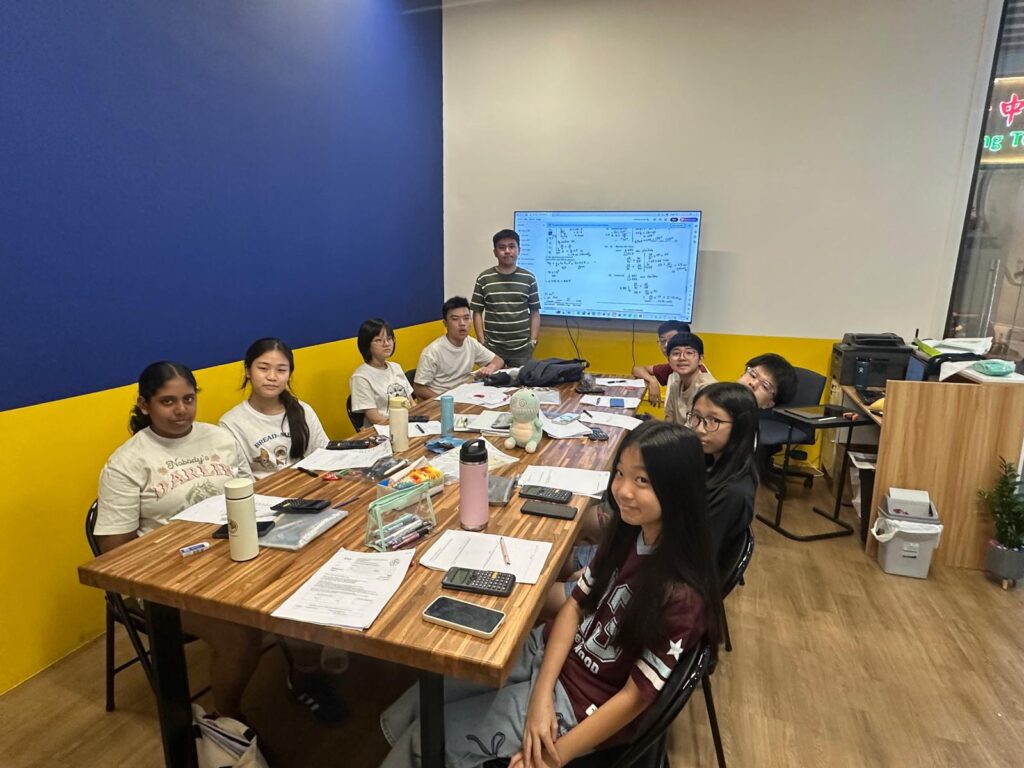
Our students describe the teaching in their own words. This one is a secondary student — the approach is the same one your child would meet in a primary class, taught at the right level. More are on Odyssey Math TV.
Where Odyssey fits
Everything here applies across our maths tuition programme, including secondary maths tuition.
Our topical tests exist to keep that weakness list honest, so practice at home can be aimed rather than general.
We teach maths only, in small classes at Hexacube, 160 Changi Road #01-02, about three minutes from Eunos MRT. See the primary and secondary programmes, our MOE-aligned curriculum, schedules and fees, or the tutors who teach. Free video solutions to past-year papers are on Odyssey Math TV.
Almost every primary topic is scaffolding for a later one, and the scaffolding is invisible until it gives way. That is why our curriculum is written across all six years, Primary 1 to Primary 6, rather than level by level — it lets us see the whole structure a child is standing on, not just the step they are currently on.
If you are unsure whether tuition is the right answer yet, the free trial is a reasonable way to find out without committing to anything. We will give you an honest read on where your child stands and what would actually help. Book a free trial class or WhatsApp +65 8512 6882.
What we describe here comes from teaching this syllabus in our own classes since 2012. It is not a forecast for any individual child: progress is produced jointly, by a student willing to do the work with support at home. We do not promise grades. Topics follow the MOE primary mathematics syllabus — check the current syllabus on the MOE website for the definitive version, and see our curriculum page for how we teach it.
Related reading
- How to Review a Wrong PSLE Maths Answer
- The Model Method at PSLE Level: When It Still Earns Marks
- Notation Errors in H2 Mathematics
- The Risk of Copying AI Maths Solutions
-end
Frequently asked questions
How many maths questions a day should a primary child do?
There is no single number. Fifteen focused minutes on the right topic beats an hour on the wrong one.
Is daily practice necessary?
For facts that need to be automatic, frequent short practice helps considerably. For problem-solving, two or three good sessions a week is usually enough.
When should we stop a session?
When accuracy starts falling. Continuing past that point trains carelessness.
Should practice cover everything or just weak areas?
Mostly weak areas, with occasional mixed sets so recognition is practised too.