
Primary 6 covers average as total value divided by number of data, and the relationship between average, total value and number of data.
What average actually asks of a Primary 6 student
Average is the first statistical measure a child meets, and the relationship between the three quantities is what actually gets examined.
Average = total ÷ number. Rearranged, total = average × number, and it is the rearranged form that most questions need.
Once a child sees that the total can always be recovered from the average, the harder questions — combining groups, finding a missing value — become routine.
What the syllabus covers
Under the MOE primary mathematics syllabus, average at Primary 6 covers:
- average as total value divided by number of data
- relationship between average, total value and number of data
Where the marks actually go
Averaging the averages when two groups of different sizes are combined, which is wrong unless the groups are the same size.
Dividing by the wrong count, particularly when a value of zero is included and forgotten.
Failing to recover the total first in questions asking for a missing value.
How to practise this properly
Always find the total first. Almost every non-trivial average question is solved by recovering totals, combining them, and dividing once at the end.
Practise the three forms of the relationship until any two quantities give the third without hesitation.
Work combined-group questions deliberately, since averaging the averages is such an attractive shortcut.
Sanity-check that the average lies between the smallest and largest values in the set.
Practise questions where one value changes and the average must be recalculated. Recovering the total, adjusting it, and dividing again is the pattern behind almost every harder average question, and it is far more useful than repeated practice of the basic calculation.
What this leads to
Secondary statistics builds on this with mean, median and mode, and with grouped data. The total-and-count relationship stays central throughout.
Mathematics at primary level does not reset each year, so neither does our teaching. The same MOE-aligned curriculum runs from Primary 1 to Primary 6, which means we can tell the difference between a child who has not met an idea and one who met it and never secured it. Those two situations look identical on a worksheet and need completely different responses.
What lessons at Odyssey are actually like
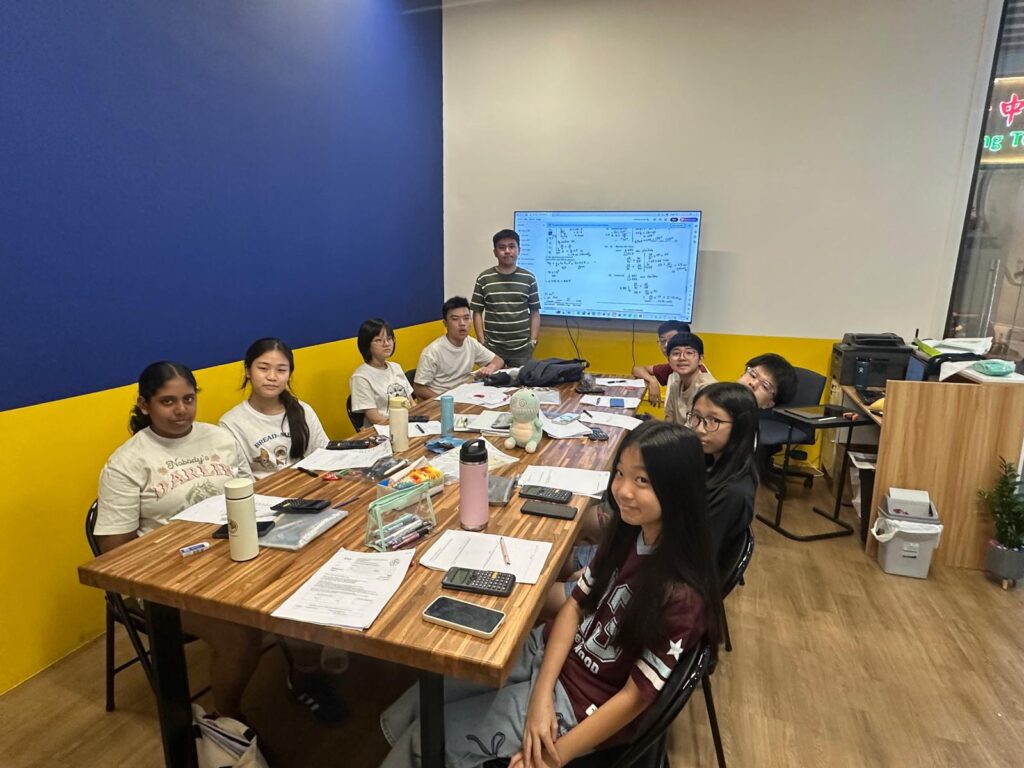
What the teaching looks like from a student’s side. This is a secondary student — primary lessons follow the same approach at an age-appropriate pace. More are on Odyssey Math TV.
Getting help with this topic
This topic is taught in the Primary 6 programme at our Eunos centre, part of maths tuition at Odyssey covering Primary 1 through JC2.
We teach Primary 6 maths in small classes at Hexacube, 160 Changi Road #01-02, about three minutes from Eunos MRT. You can see our class schedules and fees, read about our math tutors, or look through the primary school math tuition programme as a whole. If your child is in a nearby school, our primary school directory may be useful too.
The trial lesson is free and diagnostic. You will leave knowing what we think the cause of the difficulty is and what we would do about it, whether or not you go on to enrol. That seems a fairer basis for a decision than a brochure. Arrange one or WhatsApp +65 8512 6882.
What we describe here comes from teaching this syllabus in our own classes since 2012. It is not a forecast for any individual child: progress is produced jointly, by a student willing to do the work with support at home. We do not promise grades. Topics follow the MOE primary mathematics syllabus — check the current syllabus on the MOE website for the definitive version, and see our curriculum page for how we teach it.
Related reading
- Unknown Angles in Composite Figures: A Primary 6 Geometry Guide
- Working Backwards from Volume: A Primary 6 Guide
- Algebra at Primary 6: Letters, Expressions and Simple Equations
- Area and Circumference of a Circle: A Primary 6 Guide
- Primary 6 Math: The Final-Year Plan
-end
Frequently asked questions
How is average calculated?
Total value divided by the number of data.
Can you average two averages?
Only if both groups contain the same number of values. Otherwise recover both totals, add them, and divide by the combined count.
How do you find a missing value?
Multiply the average by the number of data to get the total, then subtract the values you know.
Should the average be one of the values in the set?
Not necessarily. It often is not, and it should always lie between the smallest and largest values.