
Primary 1 money covers counting an amount of money in cents up to $1 and in dollars up to $100. Mixed dollars-and-cents amounts come later.
What money actually asks of a Primary 1 student
Money is the first place a child meets mathematics attached to something they already care about, which makes it unusually motivating — and unusually revealing. A child who is shaky on place value will show it here faster than anywhere else.
At Primary 1 the two systems are kept separate: amounts in cents up to a dollar, and amounts in dollars up to a hundred. Combining them comes later, and rushing that step is a common way to create confusion.
What the syllabus covers
Under the MOE primary mathematics syllabus, money at Primary 1 covers:
- counting amount of money in cents up to $1
- counting amount of money in dollars up to $100
Where the marks actually go
Notation is where the marks go. Writing 5c as $5, or omitting the dollar sign entirely, is marked wrong even when the counting was right.
Children frequently count mixed coins by number rather than by value — treating five coins as “five” regardless of whether they are ten-cent or fifty-cent pieces.
Ordering amounts trips up children who compare the digits instead of the values, the same underlying weakness that shows up in comparing plain numbers.
How to practise this properly
Use real coins if you have them. The physical difference in size and value gives a child something concrete to attach the abstraction to, and it makes counting by value natural rather than effortful.
Ask for the same amount made up in more than one way. Twenty cents as two tens or four fives is the beginning of understanding equivalence, which matters again in fractions.
Practise writing amounts as well as counting them, so the notation is drilled alongside the arithmetic rather than after it.
What this leads to
Primary 2 extends money to larger amounts and, in later years, to decimal notation and to percentage, discount and GST at Primary 5. The habit of treating the dollar sign and the decimal point as part of the answer starts here.
A weakness at this stage rarely announces itself. It surfaces a year or two later wearing a different name, which is why parents so often report that the trouble “started” in a year where it merely became visible. Teaching Primary 1 through Primary 6 on one curriculum is what makes tracing it back to the real starting point practical rather than speculative.
What lessons at Odyssey are actually like
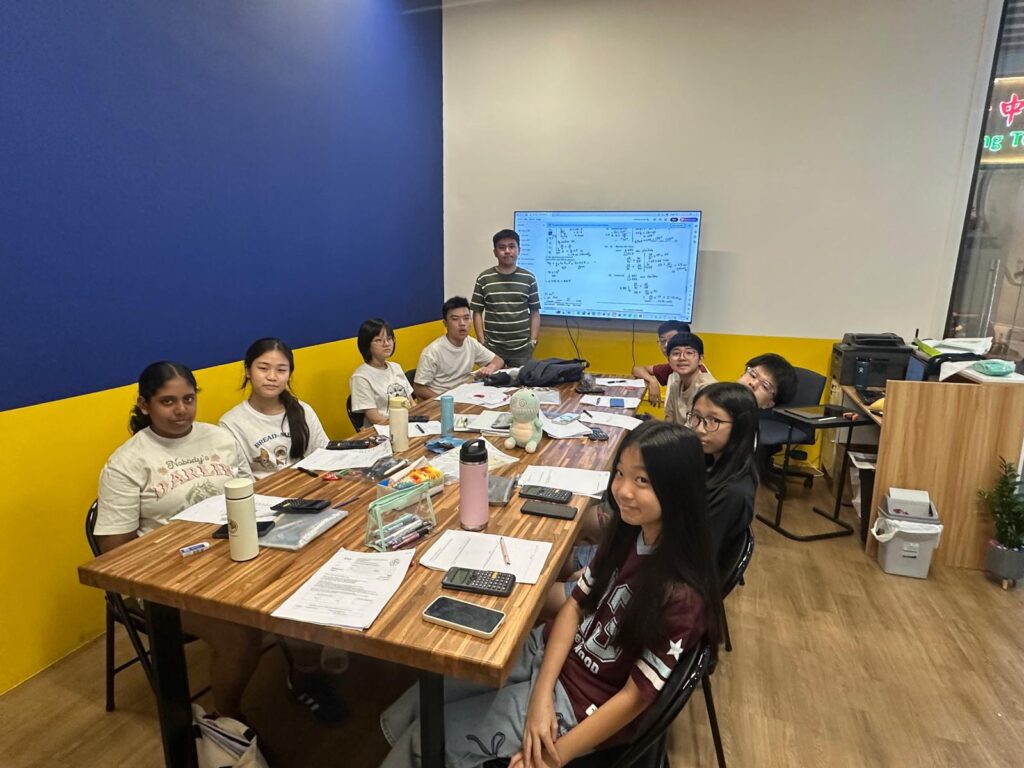
What the teaching looks like from a student’s side. This is a secondary student — primary lessons follow the same approach at an age-appropriate pace. More are on Odyssey Math TV.
Getting help with this topic
This topic is taught in the Primary 1 programme at our Eunos centre, part of maths tuition at Odyssey covering Primary 1 through JC2.
We teach Primary 1 maths in small classes at Hexacube, 160 Changi Road #01-02, about three minutes from Eunos MRT. You can see our class schedules and fees, read about our math tutors, or look through the primary school math tuition programme as a whole. If your child is in a nearby school, our primary school directory may be useful too.
Come and sit in on a lesson before deciding anything. The first one is free and its purpose is diagnostic: we want to know what your child can actually do, not what a report card says. Arrange a free trial or WhatsApp +65 8512 6882.
What we describe here comes from teaching this syllabus in our own classes since 2012. It is not a forecast for any individual child: progress is produced jointly, by a student willing to do the work with support at home. We do not promise grades. Topics follow the MOE primary mathematics syllabus — check the current syllabus on the MOE website for the definitive version, and see our curriculum page for how we teach it.
Related reading
- Money in Dollars and Cents: A Primary 2 Guide
- Picture Graphs at Primary 1: Reading Data for the First Time
- Length at Primary 1: Measuring in Centimetres
- Multiplication and Division at Primary 1: What It Really Covers
- Primary 1 Math: What “Ready” Actually Looks Like
-end
Frequently asked questions
Does Primary 1 cover dollars and cents together?
No. The syllabus keeps them separate at this level — cents up to $1, and dollars up to $100. Mixed amounts come later, once place value is more secure.
How should my child write amounts of money?
Consistently, using either the dollar sign or the cent abbreviation, and never both for the same figure. Marks are lost for notation more often than for counting at this level.
Are real coins better than pictures?
For most children, yes, at least at the start. Handling coins makes value tangible in a way that a worksheet image does not.
My child counts coins by how many there are rather than what they are worth. What do I do?
Sort the coins by type first, count each type, then total. Separating the two steps makes the distinction between quantity and value explicit.