
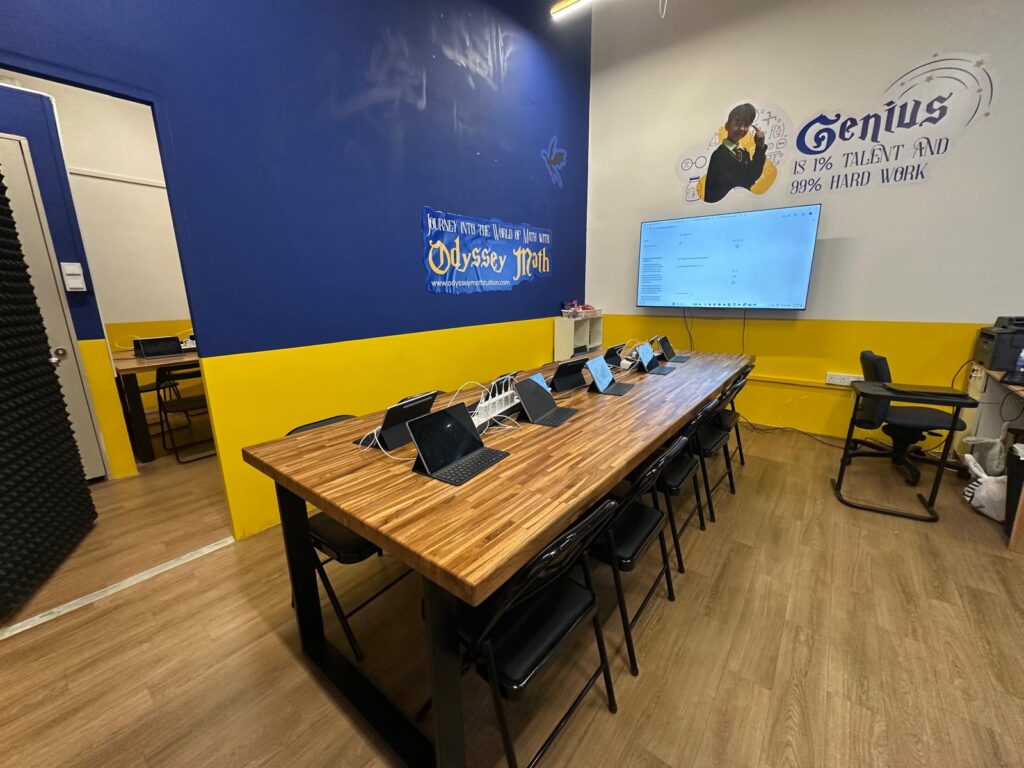
The useful distinction in screen-based study is not screen versus paper but active versus passive. A student pausing a video to work a question on paper is doing something quite different from one watching a solution scroll past, though both look identical from the doorway. Odyssey Math Tuition’s courses pair every explanation with practice and a marked test.
The wrong question
Parents reasonably ask whether learning from a screen is as effective as learning from a book or a classroom. Framed that way the question does not have a useful answer, because the medium is not doing the work either way.
What determines retention is whether the student generated anything. Reading a page passively and watching a video passively tend to produce similarly little; working problems from either produces similarly much.
What passive study looks like
- Video running continuously, nothing written
- Solution opened before any attempt
- Notes that are transcripts of what was on screen
- A session that ends with a feeling rather than an output
All four feel productive. None of them require the student to retrieve anything from memory, which is the process that builds durable knowledge.
What active study looks like
- Paper out, video paused, working written down
- A question attempted before the explanation is opened
- The same question re-attempted with the video closed
- A topical test taken and reviewed
The common feature is retrieval. Each of these requires the student to produce something rather than recognise something, and recognition is the trap that makes passive study feel effective.
Why mathematics is unusually sensitive to this
In a subject where the goal is to remember information, passive review has some value. In mathematics the goal is to perform a procedure under time, and watching someone else perform it transfers poorly.
This is why the online math tuition courses are structured as explanation, then topical practice, then a topical test. The explanation is the input; the practice and the test are where anything happens. It is also why revision plans should move to timed work rather than more review.
Spacing beats duration
The second factor after active versus passive is when the study happens rather than how long it lasts.
A topic worked for thirty minutes on Monday and revisited for fifteen on Thursday is retained better than the same forty-five minutes spent in one sitting. The gap is not wasted time; it is where consolidation happens, and retrieving something after partly forgetting it is precisely the process that makes it durable.
- Two shorter sessions a few days apart beat one long one
- Re-testing a topic a week later is worth more than re-watching it the same evening
- A topic passed immediately after repair and failed a week later was never secure
- Revision that only happens the night before measures short-term recall, which examinations do not reward
This is why the topical tests are worth re-taking rather than treating as one-time checkpoints, and why upper-secondary work punishes cramming more than lower secondary does — there is simply more material for short-term recall to hold. Every level from Secondary 1 to JC2 H2 Mathematics online course includes re-takeable topical tests, and our test for whether tuition is needed is worth reading before adding anything.
Making a screen session active
- Largest screen available, paper and pen beside it.
- Attempt before watching, always.
- Pause and write in your own words rather than transcribing.
- Close everything and redo the question.
- Finish with a topical test rather than another video.
None of this is about the device. It is about whether the student produced anything, which is checkable from the doorway by looking for paper.
What we describe here comes from how our own online courses are built and from what we have seen in our own classes. It is not a forecast for any individual student: progress is produced jointly, by a student willing to put in the work with support at home. We do not promise grades. Course details and prices are as published at the time of writing — check the course pages for current information.
Read next
Related reading on studying maths online: Why Worked Solutions Still Matter More Than Final Answers, Revising for Mid-Year Maths Exams With an Online Course, Revising for Prelims With an Online Maths Course, Mensuration in Secondary 4 E-Math: A Revision Guide, Basic Algebra and Algebraic Manipulation: A Secondary 1 Guide. On choosing a school, our list of primary schools in Singapore and list of secondary schools in Singapore set out what differs between them.
More on getting the most from your maths
Frequently asked questions
Is learning maths from a screen less effective?
The medium matters less than whether the study was active. Passive reading and passive watching tend to produce similarly little.
What makes study active?
Retrieval — attempting questions before seeing solutions, redoing them unaided, and taking marked tests.
How can I tell from outside the room?
Look for paper. Written working is the physical residue of thinking.
Are notes from a video useful?
Only if they are in the student’s own words. Transcripts of what was on screen are another form of passive work.
Why does this matter more in maths?
Because the goal is performing a procedure under time, and watching someone else perform it transfers poorly.
How are the courses structured for this?
Every topic has an explanation, then topical practice, then a topical test.
Last reviewed July 2026. Syllabus details follow the Ministry of Education and SEAB published documents.