
A useful test: if your child can work through a past-year paper for their level at around seventy per cent unaided and explain their errors afterwards, they may need structured practice rather than tuition. Tuition earns its place where the gap is conceptual.
We turn away a meaningful number of enquiries each year, and this article explains the reasoning. Tuition is genuinely useful for some problems and a poor fit for others, and the distinction is checkable at home in about an hour.
The reason is straightforward commercial honesty: a family who enrols a child who did not need it will conclude within a term that tuition does not work, and they will be right about their own case. That is worse for us than the enquiry we declined.
The test below costs nothing but an afternoon, and it distinguishes between three different problems that all present as “my child is struggling with maths” and need entirely different responses.
The test
- Download a past-year paper for your child’s level and set the real time limit.
- Sit nearby. Do not help. Note where they pause and where they stop.
- Mark it honestly, or use the worked solutions.
- Ask them to explain two errors — one they can fix on sight, one they cannot.
Our past-year papers are free with worked video solutions, so this costs nothing but the afternoon.
Reading the result
Around 70% or above, errors explainable. Your child understands the material and needs volume and timing, not teaching. Structured practice and honest marking will likely close the gap.
This is the outcome most parents are surprised by, and it is the most common one among the enquiries we decline. A student in this position does not have a mathematics problem. They have a volume-and-timing problem, and the honest recommendation is structured practice, honest marking, and someone to hold them to a schedule — none of which requires a tuition centre.
Around 70%, errors not explainable. There is a conceptual gap hiding behind adequate marks. This is where support genuinely helps, and where it is often not sought because the marks look acceptable.
Well below, with recurring error types. A foundational gap, usually from an earlier year. This needs diagnosis rather than more practice at the current level.
Well below, but errors vary randomly. Often attention or timing rather than mathematics. Worth investigating before assuming a content problem.
Free practice material. Our past-year exam papers are free to download, with worked video solutions. No sign-up required.
Four situations where tuition is the wrong tool
When the problem is organisational. A student who understands the work but does not do it needs structure at home, not another class.
When the problem is sleep or workload. A tired student makes errors that look mathematical and are not.
When the child is very young. At Primary 1 and 2, formal tuition frequently does more harm than good. Our Primary 1 page is candid about this.
When the parent is more worried than the child. Anxiety is transmissible, and tuition undertaken to relieve parental worry rarely helps the student.
Where it genuinely helps
Where there is a conceptual gap that repeated practice has not closed. Where a student has stopped believing they can do mathematics and needs evidence to the contrary. Where the household cannot realistically supervise the work. And at transition points — Secondary 1 and Secondary 3 — where the method changes rather than the difficulty.
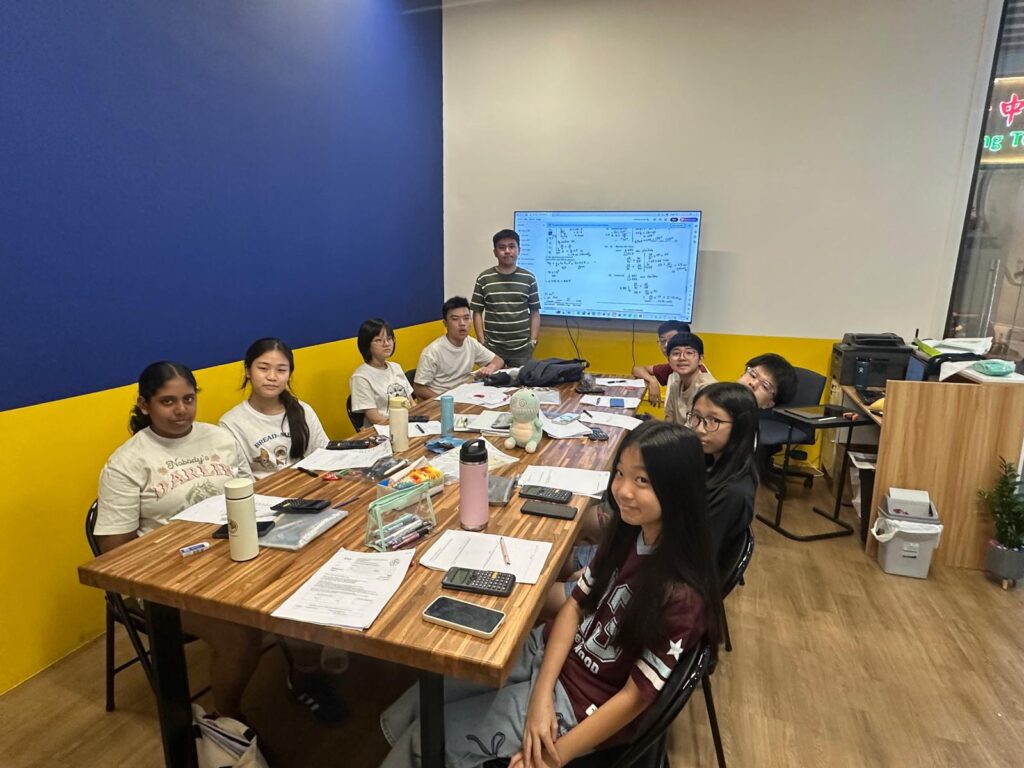
Sit in on a lesson first. We run a free trial class at our centre at Hexacube, 160 Changi Road — about three minutes from Eunos MRT. Message us on WhatsApp to book, or see class schedules and fees.
If you are unsure, our FAQ sets out how we assess this, and we will tell you if we think you should wait.
Read next
If the test points towards support, the nine criteria we judge ourselves against and how to choose a math tuition centre come next, followed by what a trial lesson should involve. On cost, our honest breakdown of fees. For very young children, why we rarely recommend tuition at Primary 1. For the youngest children, Primary 2 and building number sense explains what helps before formal tuition does. If you are choosing a school as well as a tuition centre, our list of primary schools in Singapore and list of secondary schools in Singapore are the companion directories. On studying this online, see Presentation and Method Marks in a Maths Paper, Maths Crash Courses: What They Are and When to Use One and Topical Tests as Diagnosis, Not Decoration.
Related guides
Frequently asked questions
My child is passing but I think they could do better. Is tuition justified?
Sometimes, particularly if they cannot explain their errors — that pattern indicates procedural knowledge without understanding, which caps progress later. But “could do better” applies to nearly every student, and it is worth being specific about what better means.
Everyone else has tuition. Are we disadvantaging our child?
Not by itself. What disadvantages a child is an unaddressed gap, whoever addresses it. A student practising well independently is not behind a student attending a class passively.
How do I tell a maths problem from a confidence problem?
Ask your child to attempt a question you know they can do, framed casually with no stakes attached. A student with a confidence problem often solves it easily once the pressure is removed. A student with a genuine content gap does not, regardless of framing.
My child is passing. Is tuition still justified?
Sometimes, particularly if they cannot explain their errors — that pattern indicates procedure without understanding, which caps progress later. But “could do better” applies to nearly every student, so it is worth being specific about what better would actually mean.
What if the real problem is motivation, not maths?
Then tuition is the wrong tool, and adding hours usually makes it worse. A student who understands the work but does not do it needs structure and a conversation, not another class. We would say so rather than take the enrolment.
How long should we try tuition before judging it?
One term is a fair test, provided you receive a specific diagnosis within the first month. In our classes, understanding has typically shifted in three to four weeks with marks following roughly a term later, so judging on marks alone after six weeks tends to mislead in both directions.
A note on what we can and cannot promise: the patterns described here come from what we have seen in our own classes over the years. They are not a forecast for any individual student. Progress in mathematics is produced jointly — our teachers work hard for a student who is willing to put in the effort, with support at home. We do not promise grades.
Last reviewed July 2026. Syllabus details follow the Ministry of Education and SEAB published documents.