
Primary 3 covers the concept of an angle, right angles, and identifying angles greater than or smaller than a right angle. Measuring in degrees comes later.
What angles actually asks of a Primary 3 student
An angle is an amount of turn, not a shape or a length — and that is a genuinely difficult idea. Children reliably think a longer pair of arms makes a bigger angle.
Nothing is measured in degrees at this level. The task is to compare against a right angle, which gives a reference point before any protractor work begins.
What the syllabus covers
Under the MOE primary mathematics syllabus, angles at Primary 3 covers:
- concepts of angle
- right angles, angles greater than/smaller than a right angle
Where the marks actually go
Judging angle size by the length of the arms rather than by the opening between them. This is the central misconception of the topic.
Failing to recognise a right angle when the shape is rotated, because the child is looking for the familiar upright corner.
Confusing an angle with the corner of a shape, so questions about turns are answered as questions about vertices.
How to practise this properly
Use a corner of paper as a right-angle tester and physically compare it against angles. It gives an objective check that does not depend on the child’s eye.
Draw the same angle with long and short arms and ask which is bigger. Meeting the misconception head-on works better than explaining it away.
Look for right angles in rotated positions — a tilted picture frame, a diagonal corner. Recognition should not depend on orientation.
What this leads to
Primary 4 measures angles in degrees with a protractor; Primary 5 covers angles on a line, at a point and vertically opposite, and Primary 6 finds unknown angles in composite figures. This is the conceptual foundation for all of it.
A weakness at this stage rarely announces itself. It surfaces a year or two later wearing a different name, which is why parents so often report that the trouble “started” in a year where it merely became visible. Teaching Primary 1 through Primary 6 on one curriculum is what makes tracing it back to the real starting point practical rather than speculative.
What lessons at Odyssey are actually like
What the teaching looks like from a student’s side. This is a secondary student — primary lessons follow the same approach at an age-appropriate pace. More are on Odyssey Math TV.
Getting help with this topic
This topic is taught in Primary 3 maths tuition in Singapore at our Eunos centre, part of the full maths tuition programme covering Primary 1 through JC2.
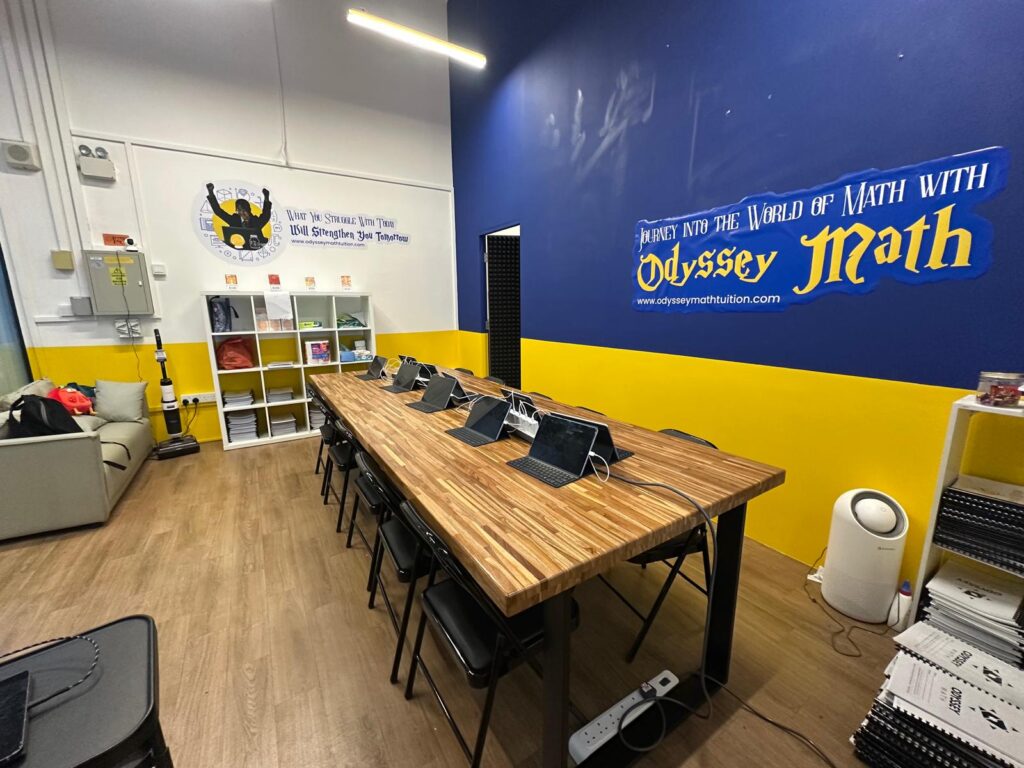
We teach Primary 3 maths in small classes at Hexacube, 160 Changi Road #01-02, about three minutes from Eunos MRT. You can see our class schedules and fees, read about our math tutors, or look through the primary school math tuition programme as a whole. If your child is in a nearby school, our primary school directory may be useful too.
Come and sit in on a lesson before deciding anything. The first one is free and its purpose is diagnostic: we want to know what your child can actually do, not what a report card says. Arrange a free trial or WhatsApp +65 8512 6882.
What we describe here comes from teaching this syllabus in our own classes since 2012. It is not a forecast for any individual child: progress is produced jointly, by a student willing to do the work with support at home. We do not promise grades. Topics follow the MOE primary mathematics syllabus — check the current syllabus on the MOE website for the definitive version, and see our curriculum page for how we teach it.
Related reading
- Measuring and Drawing Angles: A Primary 4 Guide
- Equivalent Fractions and Simplest Form: A Primary 3 Guide
- Numbers Up to 10 000: A Primary 3 Guide
- Addition and Subtraction to 4 Digits: A Primary 3 Guide
- Primary 3 Math: When Word Problems Get Real
-end
Frequently asked questions
Do Primary 3 students measure angles in degrees?
No. Primary 3 compares angles against a right angle. Measuring with a protractor comes at Primary 4.
Why does my child think longer lines mean a bigger angle?
Because length is the property they have been measuring for three years. Drawing the same angle with different arm lengths confronts it directly.
How can my child test for a right angle?
The corner of a piece of paper is exactly a right angle and makes a reliable tester.
Does the orientation of an angle matter?
Not to its size. A right angle stays a right angle whichever way it is turned, and questions test that deliberately.