
Switching has real costs — disruption, a new method, lost continuity — so it is worth doing when the problem is diagnosis or fit, and worth avoiding when the issue is simply that progress is slow.
Reasons that usually justify switching
Nobody can tell you what specifically is being worked on, or why. A centre that reports percentages rather than causes cannot direct the effort.
The class is too large for anyone to see your child work. Attention is the product being bought, and if it is not there the rest does not matter.
The teaching is at the current level while the problem is two years back, and raising it has changed nothing.
Reasons that usually do not
Slow progress in the first term. Repairing a foundational gap takes time and the early weeks often show little.
A single disappointing result.
A child who dislikes the tutor but is making measurable progress. That is worth exploring before acting on.
Before switching, ask the current centre:
- What specifically are you working on with my child?
- What do you think is causing the difficulty?
- What should I expect to see change, and by when?
- How many children are in the class?
- How would you know if my child stopped following?
What switching costs
Continuity. A new centre needs time to diagnose, and that time is not free in an exam year.
Method conflict. Different centres teach different approaches, and a student holding two can end up less confident than before.
Momentum, particularly for students who took a while to settle.
Making it work if you do switch
Bring the marked work from the previous centre. It shortens the diagnosis considerably.
Tell the new tutor what was being worked on and what did not help.
Agree what should be observable within a term, so the same uncertainty does not repeat.
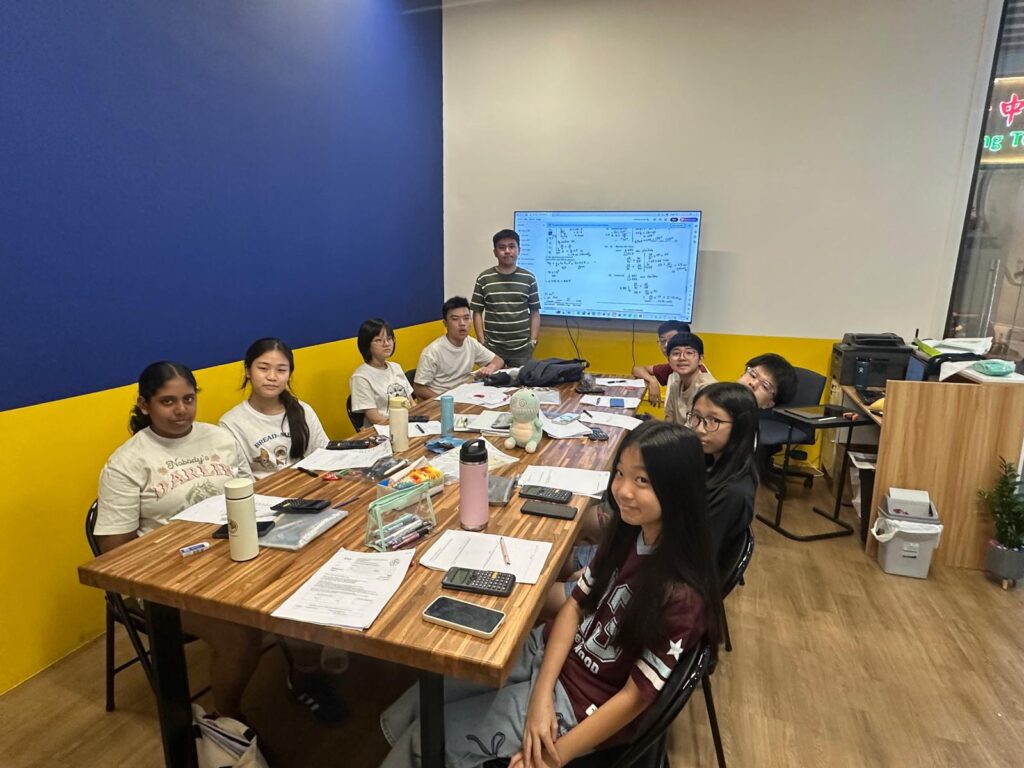
What lessons at Odyssey are actually like
Our students describe the teaching in their own words. This one is a secondary student — the approach is the same one your child would meet in a primary class, taught at the right level. More are on Odyssey Math TV.
Where Odyssey fits
We teach our maths tuition programme at our Eunos centre — see also secondary maths tuition. Students from Secondary 1 to JC2 can also work through the same material in our online maths courses.
If you are considering a change, our free trial lesson is diagnostic, and we will tell you honestly whether we think we would do better than your current arrangement.
We teach maths only, in small classes at Hexacube, 160 Changi Road #01-02, about three minutes from Eunos MRT. See the primary and secondary programmes, our MOE-aligned curriculum, schedules and fees, or the tutors who teach. Free video solutions to past-year papers are on Odyssey Math TV.
This is the case for continuity. When the same curriculum carries a child from Primary 1 to Primary 6, nobody has to reconstruct where an earlier gap was left, and no year is taught as though the previous one did not happen. It also means a child moving up does not have to adjust to a different way of explaining the same ideas.
We would rather place a child correctly than quickly. The free trial lesson tells us — and tells you — what is genuinely needed, which is sometimes less than parents expect and occasionally rather more. Book a free trial or WhatsApp +65 8512 6882.
What we describe here comes from teaching this syllabus in our own classes since 2012. It is not a forecast for any individual child: progress is produced jointly, by a student willing to do the work with support at home. We do not promise grades. Topics follow the MOE primary mathematics syllabus — check the current syllabus on the MOE website for the definitive version, and see our curriculum page for how we teach it.
Related reading
- Units, Working and Marks at PSLE
- What a PSLE AL Score Actually Measures
- What to Bring to a Maths Diagnostic Lesson
- When an Online Maths Course Is Not the Right Fit
- Switching From Physical Classes to Online Maths Mid-Year
- Revising for Mid-Year Maths Exams With an Online Course
-end
From our online course guides
- Differential Equations in H2 Mathematics: A JC2 Guide
- Discrete Random Variables and the Binomial Distribution: A JC2 Guide
Frequently asked questions
Is it disruptive to switch mid-year?
It has a real cost in continuity and diagnosis time, which is why the reason matters. Fit and diagnosis problems justify it; slow early progress usually does not.
Should I switch in an exam year?
Only for a clear reason. The time lost to re-diagnosis is more expensive in an exam year than at any other point.
What should I bring to a new centre?
Marked work from the previous one, and a note of what was being worked on and what did not help.
What if my child dislikes the tutor but is progressing?
Worth exploring the reason before acting. Measurable progress is hard to replace.