
The useful question is not what year to start but whether there is a specific gap. Tuition helps most when it targets something identifiable.
There is no standard year
Parents often ask whether Primary 3 or Primary 4 is the right time. There is no general answer, because the reason for starting matters far more than the level.
A child with a specific unresolved gap benefits at any age. A child who is coping benefits much less, and may simply become busier.
Signs that suggest a real gap
Marks falling while effort stays constant. That combination usually means something foundational is missing rather than that the child has stopped trying.
Difficulty that persists after a topic has been re-explained at home more than once.
A child who can do exercises when the topic is named but not when questions are mixed. That points at recognition rather than knowledge, which is hard to fix at home.
Avoidance. Children who dislike a subject usually dislike it because they feel incompetent at it, and that feeling tends to be evidence rather than mood.
Signs that suggest waiting
A single poor result with no pattern behind it. One test is noise.
A child already stretched across several activities. Adding an obligation to an overloaded week rarely produces the intended result.
A gap you can identify and address yourself in a few sessions. Not every difficulty needs a centre.
What to ask before committing
Ask what specifically will be worked on, and how you will know it is working. A vague answer is a warning.
Ask what happens if the diagnosis is that the difficulty lies two years back. A programme that only teaches the current level cannot address that.
Questions worth asking any centre:
- What do you think is actually causing the difficulty?
- What will you work on first, and why that?
- How will we know in two months whether it is working?
- What happens if the cause turns out to be from an earlier year?
- How large is the class, and who teaches it?
What lessons at Odyssey are actually like
One of our students, unscripted, on how the lessons run. Secondary level in this clip; the same method underlies the primary classes. More are on Odyssey Math TV.
Where Odyssey fits
Everything here applies across the full maths tuition programme, including primary maths tuition.
Our first lesson is a free trial used as a diagnosis. If we think a child does not need tuition yet, we say so.
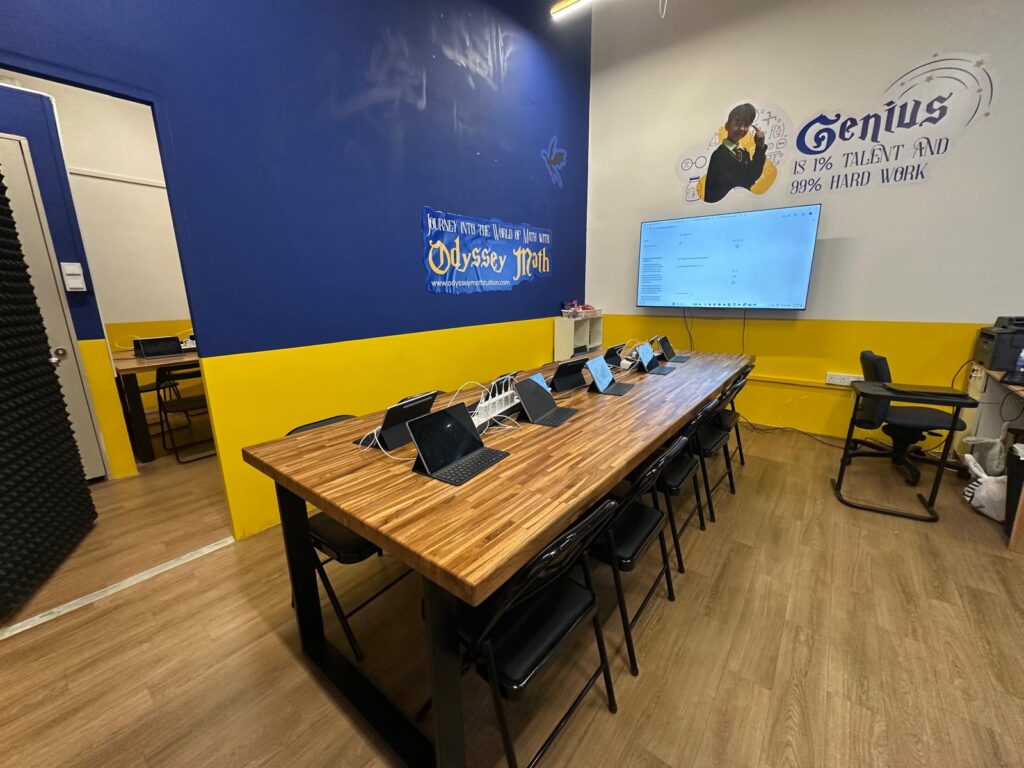
We teach maths only, in small classes at Hexacube, 160 Changi Road #01-02, about three minutes from Eunos MRT. See the primary and secondary programmes, our MOE-aligned curriculum, schedules and fees, or the tutors who teach. Free video solutions to past-year papers are on Odyssey Math TV.
This is the case for continuity. When the same curriculum carries a child from Primary 1 to Primary 6, nobody has to reconstruct where an earlier gap was left, and no year is taught as though the previous one did not happen. It also means a child moving up does not have to adjust to a different way of explaining the same ideas.
We would rather place a child correctly than quickly. The free trial lesson tells us — and tells you — what is genuinely needed, which is sometimes less than parents expect and occasionally rather more. Book a free trial or WhatsApp +65 8512 6882.
What we describe here comes from teaching this syllabus in our own classes since 2012. It is not a forecast for any individual child: progress is produced jointly, by a student willing to do the work with support at home. We do not promise grades. Topics follow the MOE primary mathematics syllabus — check the current syllabus on the MOE website for the definitive version, and see our curriculum page for how we teach it.
Related reading
- What to Bring to a Maths Diagnostic Lesson
- When an Online Maths Course Is Not the Right Fit
- AI-Generated Maths Worksheets: A Verification Checklist
- Calculator Mistakes in Secondary Maths
-end
Frequently asked questions
Is Primary 3 too early for tuition?
It depends entirely on whether there is a specific gap. Age matters much less than cause.
My child is coping but not excelling. Should I get tuition?
Possibly, but be clear about the goal. Tuition aimed at a specific weakness works better than tuition aimed at general improvement.
How long before I should expect to see a change?
Ask the centre that question directly. A reasonable answer names something observable within a term.
Can starting too early do harm?
It can, if it crowds a child’s week or teaches them that maths requires extra help they did not actually need.