
At Primary 2 the 2D shapes topic is about patterns: making and completing patterns with 2D shapes according to one or two attributes — size, shape, colour or orientation.
What 2D shapes and patterns actually asks of a Primary 2 student
This looks like an art activity and is actually early algebraic reasoning. A pattern has a rule, and the task is to work out the rule and apply it — which is precisely what sequence questions ask for years later.
The difficulty rises sharply when two attributes change at once. A pattern where shape and orientation both vary requires tracking two independent rules simultaneously.
What the syllabus covers
Under the MOE primary mathematics syllabus, 2D shapes and patterns at Primary 2 covers:
- making and completing patterns with 2D shapes according to one or two of the following attributes: size, shape, colour, orientation
Where the marks actually go
Children spot the most visually obvious attribute and miss the second one. Colour is noticed; orientation is not.
Orientation changes are the least noticed of the four attributes, because children read shapes by name rather than by position.
Patterns are continued by copying the previous item rather than by applying the rule, which works for one step and then fails.
How to practise this properly
Ask what changes and what stays the same before asking what comes next. Naming the rule out loud is the skill; producing the next shape is just the consequence.
Deliberately include patterns where orientation is the changing attribute, since that is the one children reliably overlook.
Have your child invent a pattern and challenge you to continue it. Making one requires a firmer grasp of the rule than following one.
What this leads to
Number patterns run through every primary year and become sequences at secondary level. The habit of asking “what is the rule?” starts with shapes, where the rule is visible.
Mathematics at primary level does not reset each year, so neither does our teaching. The same MOE-aligned curriculum runs from Primary 1 to Primary 6, which means we can tell the difference between a child who has not met an idea and one who met it and never secured it. Those two situations look identical on a worksheet and need completely different responses.
What lessons at Odyssey are actually like
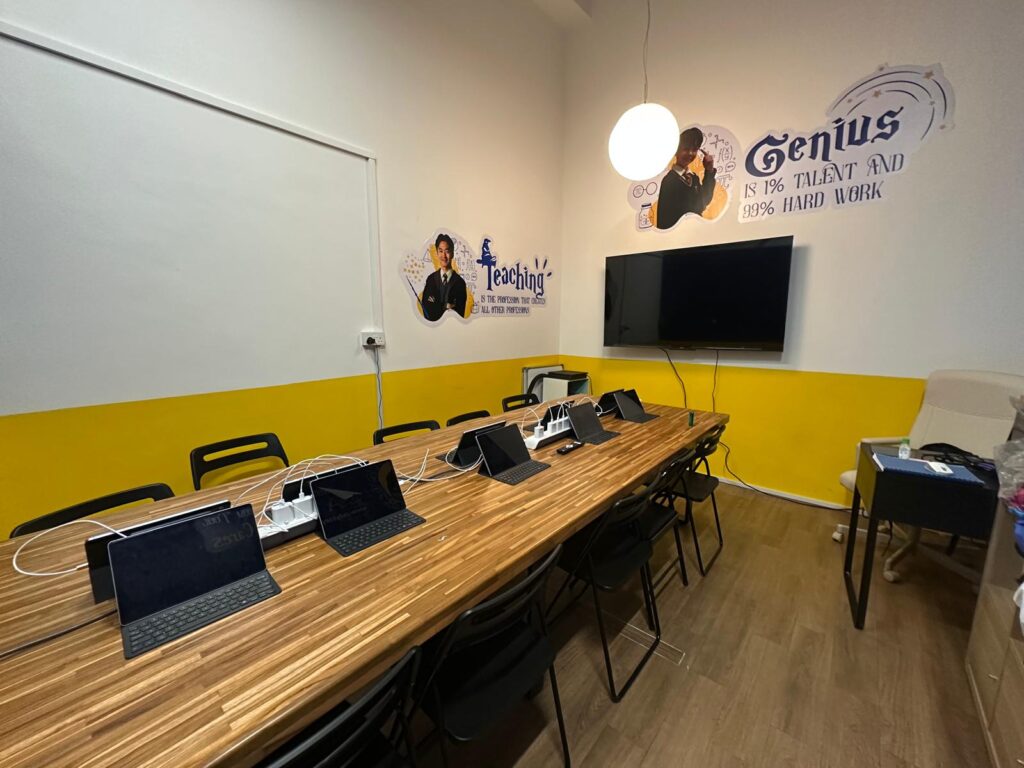
What the teaching looks like from a student’s side. This is a secondary student — primary lessons follow the same approach at an age-appropriate pace. More are on Odyssey Math TV.
Getting help with this topic
This topic is taught in Primary 2 maths tuition at our Eunos centre, part of maths tuition in Singapore covering Primary 1 through JC2.
We teach Primary 2 maths in small classes at Hexacube, 160 Changi Road #01-02, about three minutes from Eunos MRT. You can see our class schedules and fees, read about our math tutors, or look through the primary school math tuition programme as a whole. If your child is in a nearby school, our primary school directory may be useful too.
The trial lesson is free and diagnostic. You will leave knowing what we think the cause of the difficulty is and what we would do about it, whether or not you go on to enrol. That seems a fairer basis for a decision than a brochure. Arrange one or WhatsApp +65 8512 6882.
What we describe here comes from teaching this syllabus in our own classes since 2012. It is not a forecast for any individual child: progress is produced jointly, by a student willing to do the work with support at home. We do not promise grades. Topics follow the MOE primary mathematics syllabus — check the current syllabus on the MOE website for the definitive version, and see our curriculum page for how we teach it.
Related reading
- 3D Shapes at Primary 2: Cubes, Cuboids, Cones, Cylinders and Spheres
- Picture Graphs with Scales: A Primary 2 Guide
- Telling Time to the Minute: A Primary 2 Guide
- Adding and Subtracting Like Fractions: A Primary 2 Guide
- Primary 2 Math: Building the Foundation That Lasts
-end
Frequently asked questions
How many attributes can change at once at Primary 2?
Up to two, as specified in the syllabus — from size, shape, colour and orientation.
Why does my child miss orientation changes?
Because a triangle is still called a triangle whichever way up it is. Pointing out that position is part of the pattern usually fixes it in one session.
Is this topic worth much in the exam?
It carries modest marks, but the reasoning it builds — find the rule, then apply it — is worth a great deal later.
Should my child draw the patterns?
Drawing forces attention to orientation and size in a way that pointing does not, so yes where practical.