
Primary 3 covers numbers up to 10 000: counting in hundreds and thousands, place value in thousands, hundreds, tens and ones, reading and writing numbers, comparing and ordering, and patterns in number sequences.
What numbers up to 10 000 actually asks of a Primary 3 student
A fourth column arrives, and with it the last of the place-value structure a primary student needs. Everything from here to Primary 5 extends this same idea rather than replacing it.
The genuine difficulty is that numbers now have enough digits for a child to lose track. Comparing 4 072 and 4 720 requires working left to right and stopping at the first difference — a method rather than a glance.
Number patterns also get harder, because the step can now be in hundreds or thousands and may cross a boundary mid-sequence.
What the syllabus covers
Under the MOE primary mathematics syllabus, numbers up to 10 000 at Primary 3 covers:
- counting in hundreds/thousands
- number notation, representations and place values (thousands, hundreds, tens, ones)
- reading and writing numbers in numerals and in words
- comparing and ordering numbers
- patterns in number sequences
Where the marks actually go
Comparing by digit rather than by position. A child who sees a 7 in 4 072 and a 4 in 4 720 and picks the first is applying a rule that works often enough to survive undetected.
Zeros in the middle continue to cause trouble, now in two possible positions. 4 007 and 4 070 are read carelessly as the same thing.
Patterns that cross a thousands boundary — 2 800, 2 900, 3 000 — break children who are adding to the hundreds digit rather than to the number.
How to practise this properly
Compare numbers by covering all but the leftmost column, then revealing one column at a time. It makes the correct method physical rather than something to remember.
Write sequences that deliberately cross boundaries and ask what happens at the crossing. That is where the understanding is tested.
Keep reading numbers aloud. At four digits the spoken form carries the place value, so a child who can say it correctly usually writes it correctly.
What this leads to
Primary 4 goes to 100 000 and adds factors, multiples and the four operations together. Place value is not re-taught there — it is assumed.
Topics in primary mathematics are cumulative, which is the argument for treating the six years as a single programme rather than a series of annual courses. Our MOE-aligned curriculum does exactly that, from Primary 1 to Primary 6, so nothing has to be guessed about what a child was or was not taught before they arrived.
What lessons at Odyssey are actually like
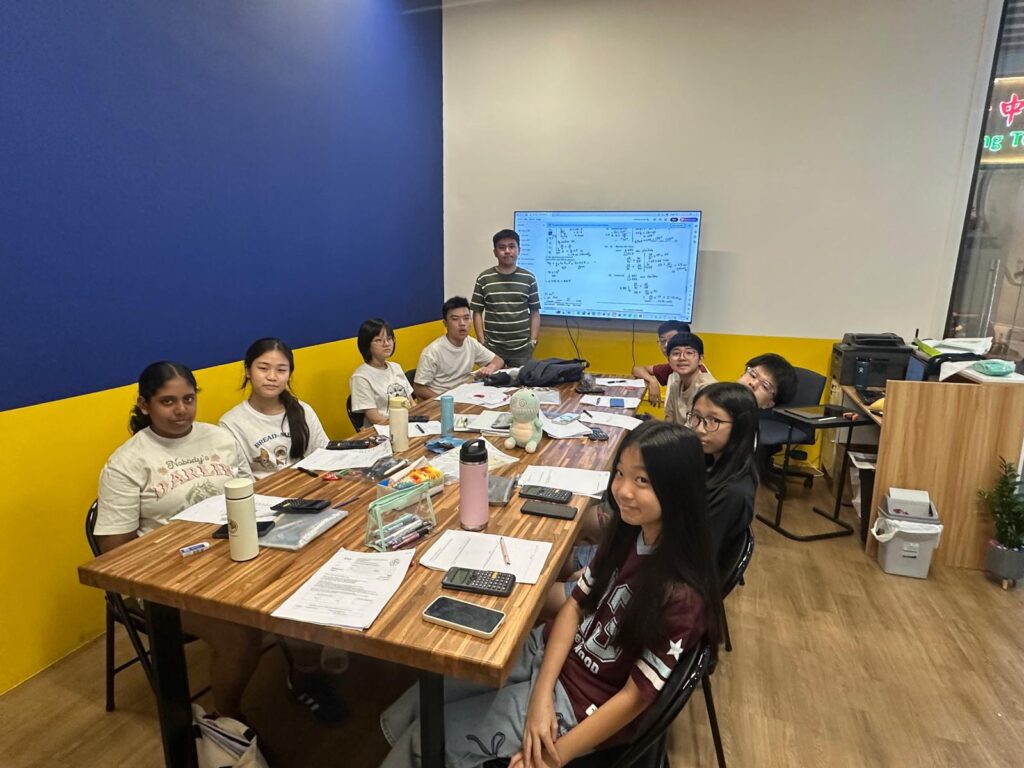
Our students describe the teaching in their own words. This one is a secondary student — the approach is the same one your child would meet in a primary class, taught at the right level. More are on Odyssey Math TV.
Getting help with this topic
This topic is taught in Primary 3 maths tuition at our Eunos centre, part of maths tuition in Singapore covering Primary 1 through JC2.
We teach Primary 3 maths in small classes at Hexacube, 160 Changi Road #01-02, about three minutes from Eunos MRT. You can see our class schedules and fees, read about our math tutors, or look through the primary school math tuition programme as a whole. If your child is in a nearby school, our primary school directory may be useful too.
If this topic is the one causing trouble at home, a free trial class is the quickest way to find out why. An hour with a tutor who has taught the whole primary syllabus usually locates the cause faster than weeks of extra worksheets. No obligation either way — book a trial or WhatsApp +65 8512 6882.
What we describe here comes from teaching this syllabus in our own classes since 2012. It is not a forecast for any individual child: progress is produced jointly, by a student willing to do the work with support at home. We do not promise grades. Topics follow the MOE primary mathematics syllabus — check the current syllabus on the MOE website for the definitive version, and see our curriculum page for how we teach it.
Related reading
- Mixed Numbers and Improper Fractions: A Primary 4 Guide
- Numbers Up to 100 000 and Rounding: A Primary 4 Guide
- Numbers Up to 1000: A Primary 2 Guide for Parents
- Perpendicular and Parallel Lines: A Primary 3 Guide
- Primary 3 Math: When Word Problems Get Real
-end
Frequently asked questions
How large are the numbers at Primary 3?
Up to 10 000, with place value covering thousands, hundreds, tens and ones.
Should numbers be written with a space or a comma?
Singapore convention uses a space, as in 4 072. Following the format used in your child’s materials avoids confusion.
My child compares numbers by looking at the digits. How do I correct it?
Teach comparing left to right, stopping at the first column that differs. Covering columns while comparing makes the method concrete.
Are number patterns really examined?
Yes, and they get progressively harder through primary school. They are also the beginning of the algebraic thinking that secondary school depends on.